The FAD Architecture Awards 2026
Several Projects Located in Barcelona Have Been Selected as Finalists for the FAD Architecture Awards
Hospital del Mar extension by Pinearq and Brullet de Luna, © Simón García
The FAD, an Institution With a History
The FAD, whose initials originally stood for Fomento de las Artes Decorativas (Promotion of Decorative Arts), was founded in Barcelona in 1903 as a professional association of artisans and decorative artists. It had an active history in its first decades, participating, for example, in the creation of the Massana School in 1929. But it was in 1958, with the creation of the FAD Architecture Award, that the association’s cultural relevance took a significant leap. The new award, which had Oriol Bohigas as one of its main founders, aimed to promote modern architecture, and especially buildings related to the Grup R, as opposed to the predominant architecture of the time, which had vernacular and conservative tendencies.
The first architects to receive it were Guillem Giráldez, Pedro López Iñigo, and Xavier Subías, for their project for the Faculty of Law, a work with openly rationalist features, designed and built in a surprising record time of 12 months. Over time, the FAD awards went from being a local prize to becoming the most prestigious award given in the Iberian Peninsula.
Llull 122 office building by BAAS Arquitectura, © Adrià Goula
The FAD Awards Enter a New Phase
The most important change in the organization and awarding of the prizes since their foundation occurred in 2006, when the FAD was renamed Fomento de las Artes y el Diseño (Promotion of Arts and Design), retaining its traditional Spanish acronym. It was at that time that the current categories of the Architecture and Interior Design Awards were established: Architecture, Interior Design, City and Landscape, Ephemeral Interventions, and Reflection and Criticism. Currently, the FAD is subdivided according to the various professional areas related to design. ARQUIN-FAD is the association corresponding to the fields of architecture, urban planning, landscape architecture, and interior design, and is therefore the direct responsible for the aforementioned awards.
The call for entries for these awards is open to projects from the Iberian Peninsula and is held annually. ARQUIN-FAD is responsible for appointing a jury made up of prestigious architects, university professors, critics, and other specialists, aiming to include a diversity of profiles. In the first stage, the jury conducts a preliminary selection of projects and then compiles a list of finalists. The projects that reach this phase are analyzed in greater detail and depth, and are also visited by the jury members before the final decision is made and the winner is announced.
Espronceda Municipal Sports Complex by Conxita Balcells Associats and Barceló-Balanzó Arquitectes, © José Hevia
The Current Edition: 2026 Finalist Projects
The list of finalists for the 2026 edition has highlighted an interesting collection of recent buildings, all of them of high quality, including several projects located in Barcelona. The category in which the local works stand out the most is City and Landscape, as two of the four finalists are in the Catalan capital. These are the Open Spaces at the Illa Diagonal by Batlleiroig Arquitectura and the final phase of the Parc de les Glòries, identified as “Urban Canopy – Tunnels Area,” by Agence TER and Ana Coello. Coincidentally, it’s a project featured in the latest Guiding Architects Barcelona blog post.
In the Architecture category, 15 finalists have been selected, four of which are located in Barcelona. This is also a considerable percentage, considering that the finalists are spread across Spain and Portugal. It’s a good opportunity to take an interest in these four projects, which join the long list of local buildings worth visiting.
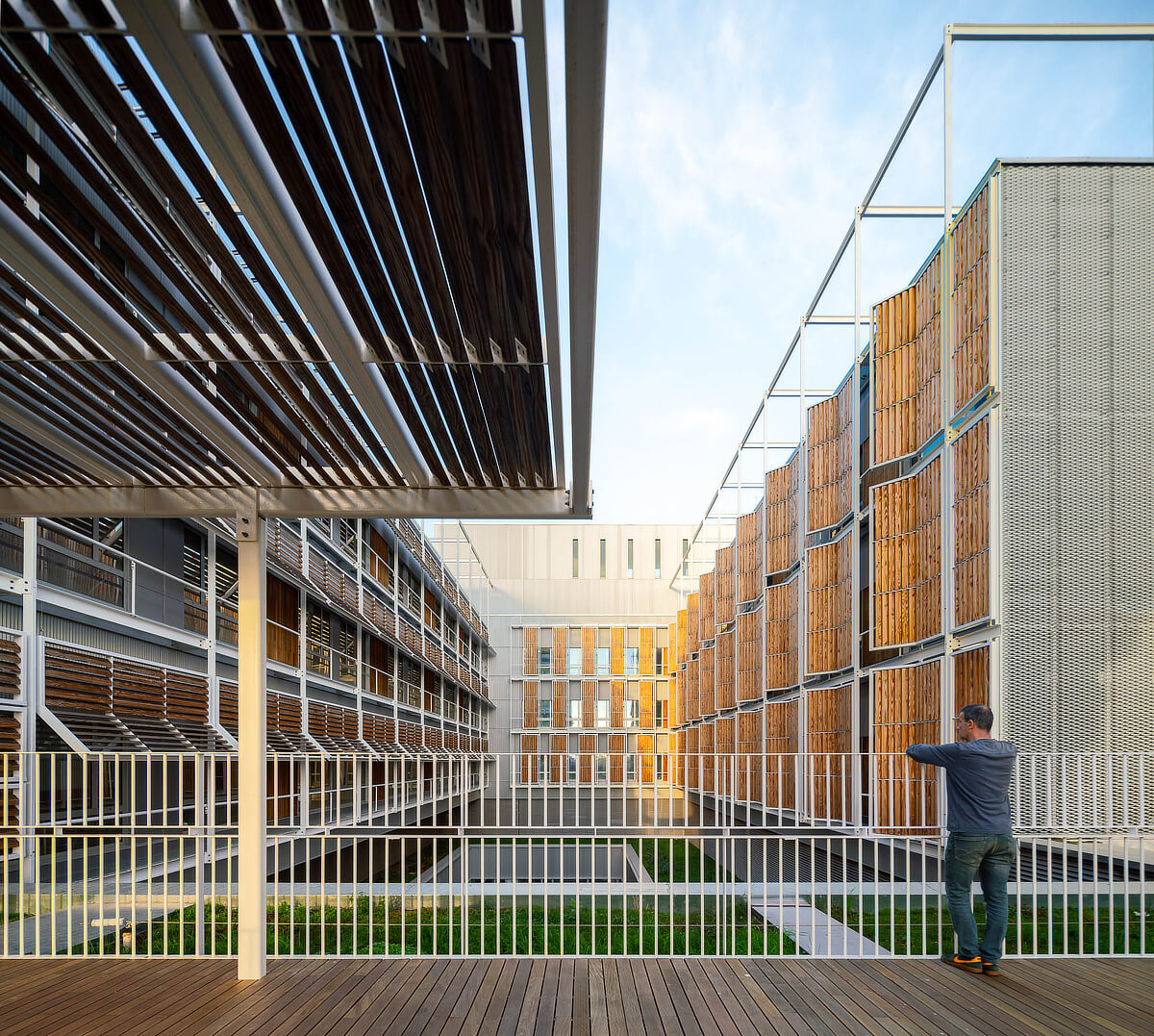
Hospital del Mar extension by Pinearq and Brullet de Luna, © Simón García
The Expansion of the Hospital Del Mar by Pinearq + Brullet de Luna
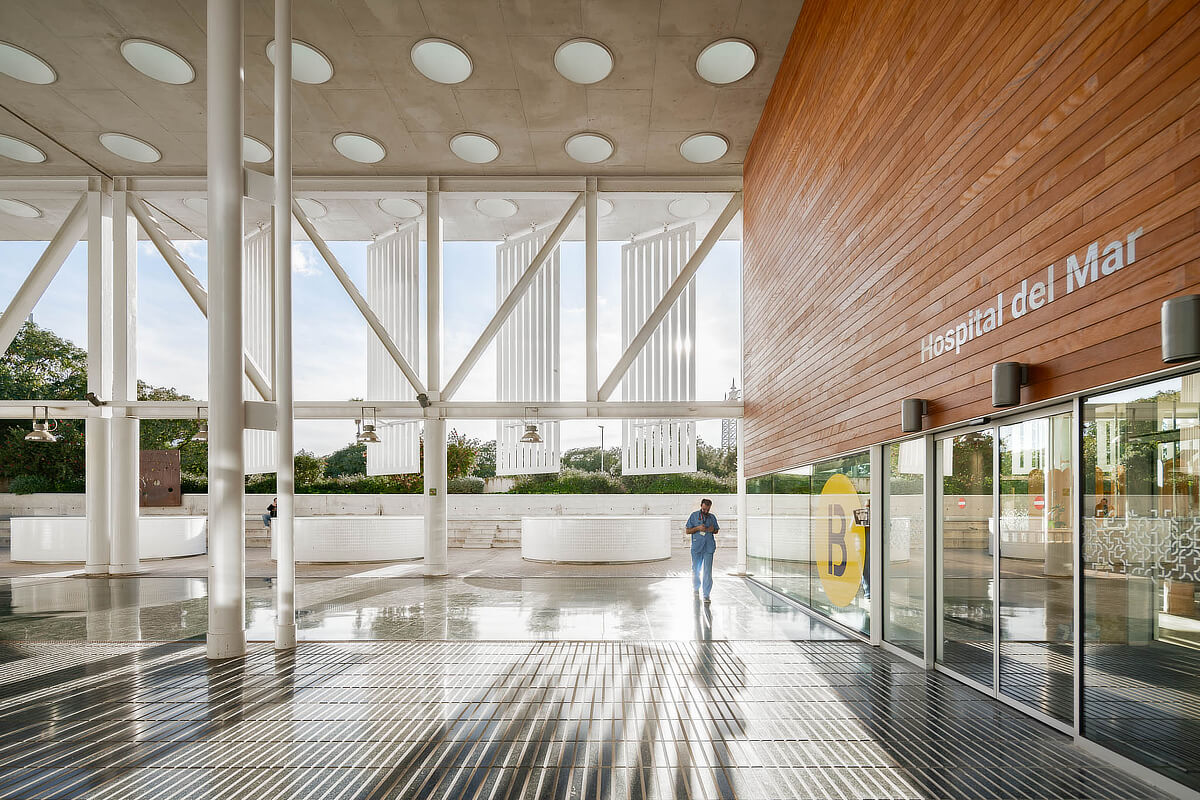
The new expansion of Hospital del Mar (Phase 2) is the latest chapter in a long history of renovations and projects carried out by the Pinearq and Brullet de Luna teams at the historic healthcare complex and its surroundings. These architects were responsible for the first major transformation of this facility, located in a prime setting, when it was proposed to serve as the Olympic hospital in 1992. That prestigious and influencial proposal was followed in 2007 by the Parc de Recerca Biomèdica, a complementary project adjacent to the hospital, featured on our blog about Scientific Research Buildings in Barcelona, and then in 2017 by the hospital’s first expansion. The recent project culminates the urban and functional transformation of a significant section of Barcelona’s waterfront.
The new building is a U-shaped block open onto Gas Street, primarily housing inpatient rooms, and is connected to the rest of the complex by a two-story horizontal volume. A metal grid is set in front of the elevated facades, framing an elegant system of wooden shutters. Aesthetically, the blinds connect the building with local tradition but also to the Parc de Recerca Biomèdica. Functionally, the shutters provide privacy to the rooms and protect the facades from excessive sun.
Facing the waterfront, the new block opens onto an attractive landscaped terrace on the third floor, designed for the relaxation of patients and medical staff, but which also enhances the hospital’s environmental performance. Sustainability criteria are also reflected in the use of certified wood, locally sourced materials, and rainwater recycling.
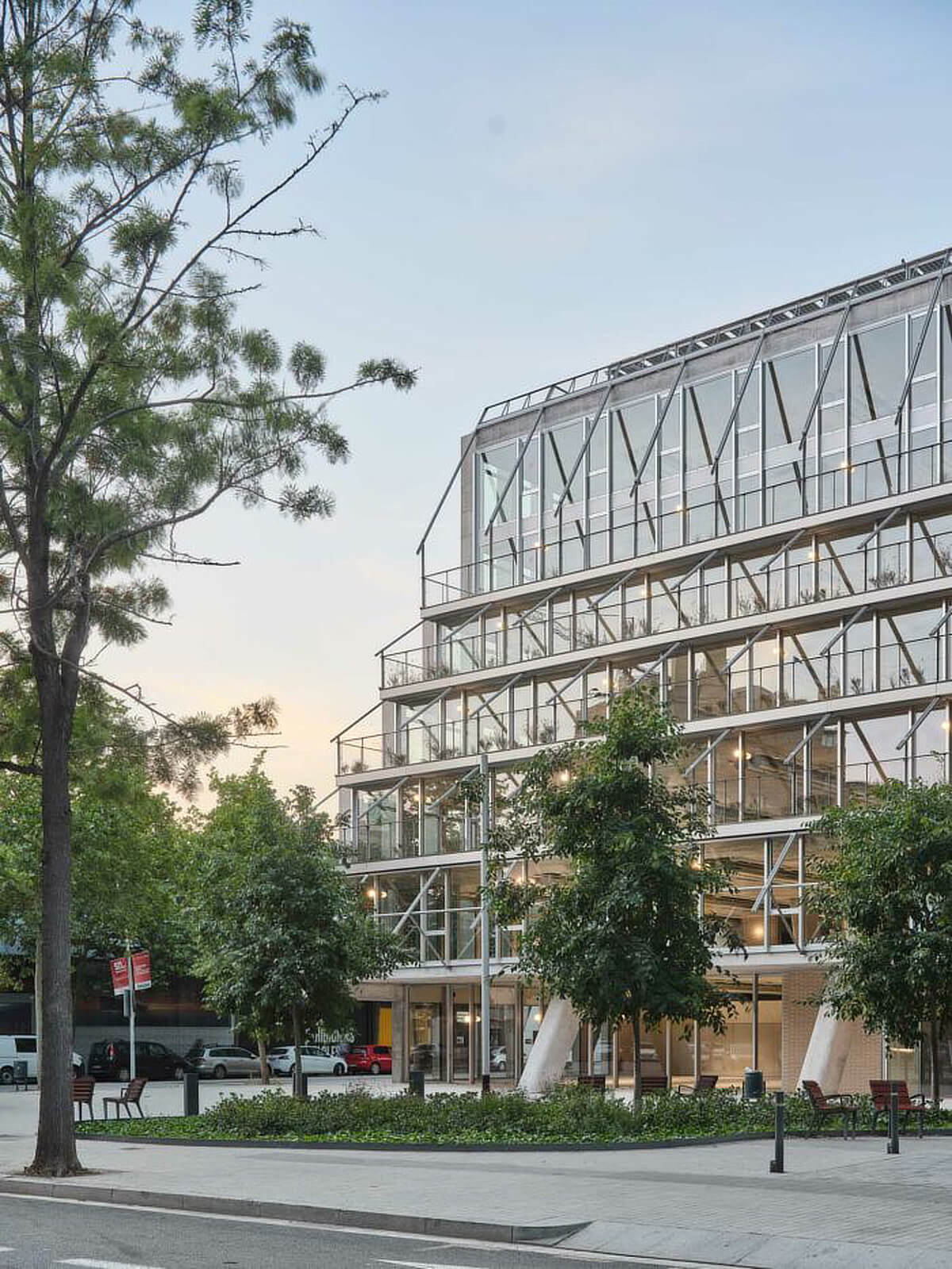
Llull 122 office building by BAAS Arquitectura, © Adrià Goula
The Llull 122 Building by Baas Arquitectura
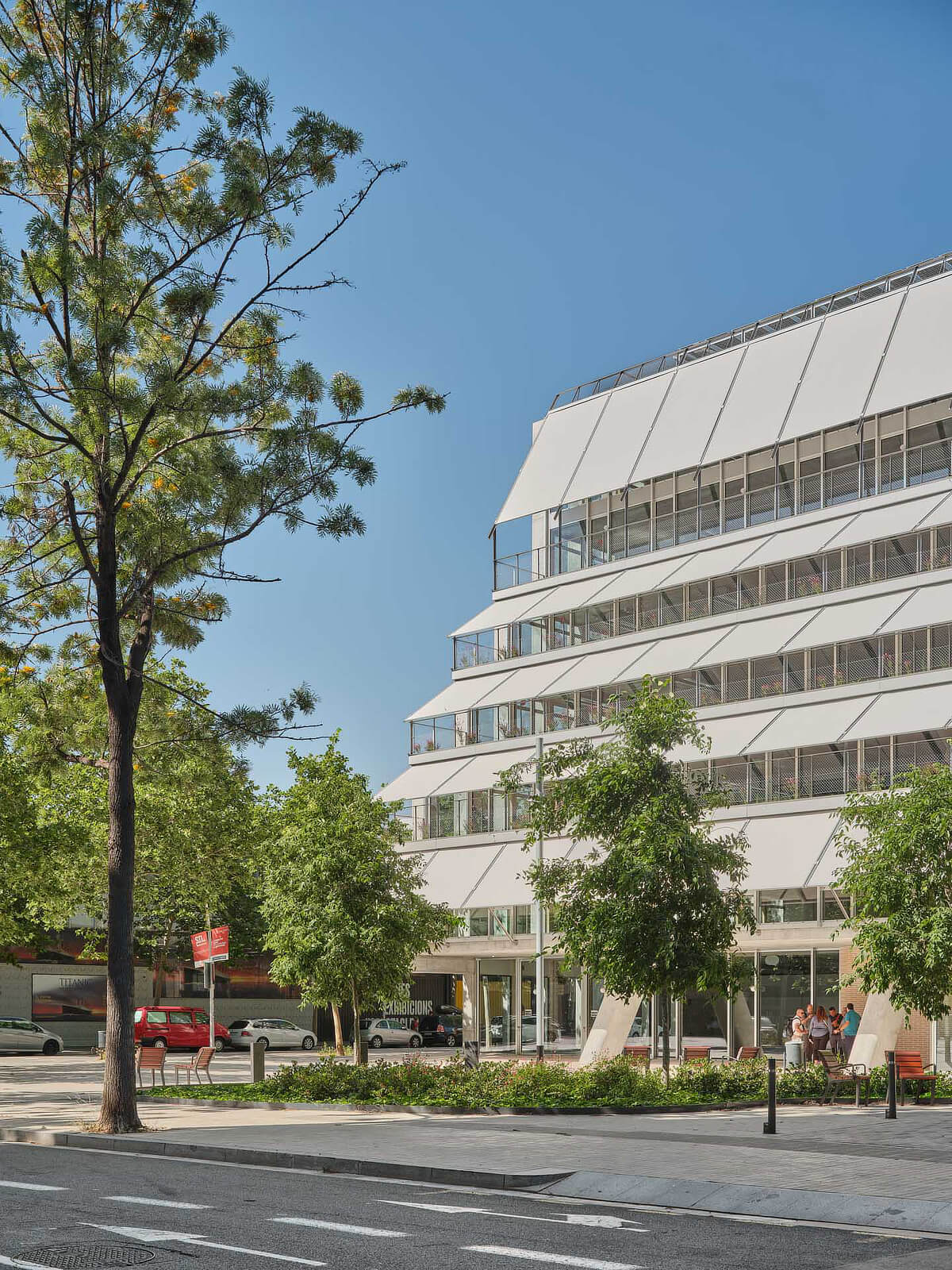
The Llull 122 office building, designed by BAAS Arquitectura, is strategically located on a corner of the 22@ district in the Poblenou neighborhood.
At first glance, two features of the building stand out: its stepped volume and its modified alignment to create a public plaza. The resulting space functions as an outdoor foyer, creating a dynamic relationship with the surroundings, reinforced by the building’s permeability on the ground floor.
The scale and configuration of the volume give the project a friendly character toward both the city and the user, creating a sequence of landscaped terraces that contrast with the exposed concrete, which is the predominant material. The two inclined pillars accompany the building’s stepped shape forming a porch as they project over the plaza.
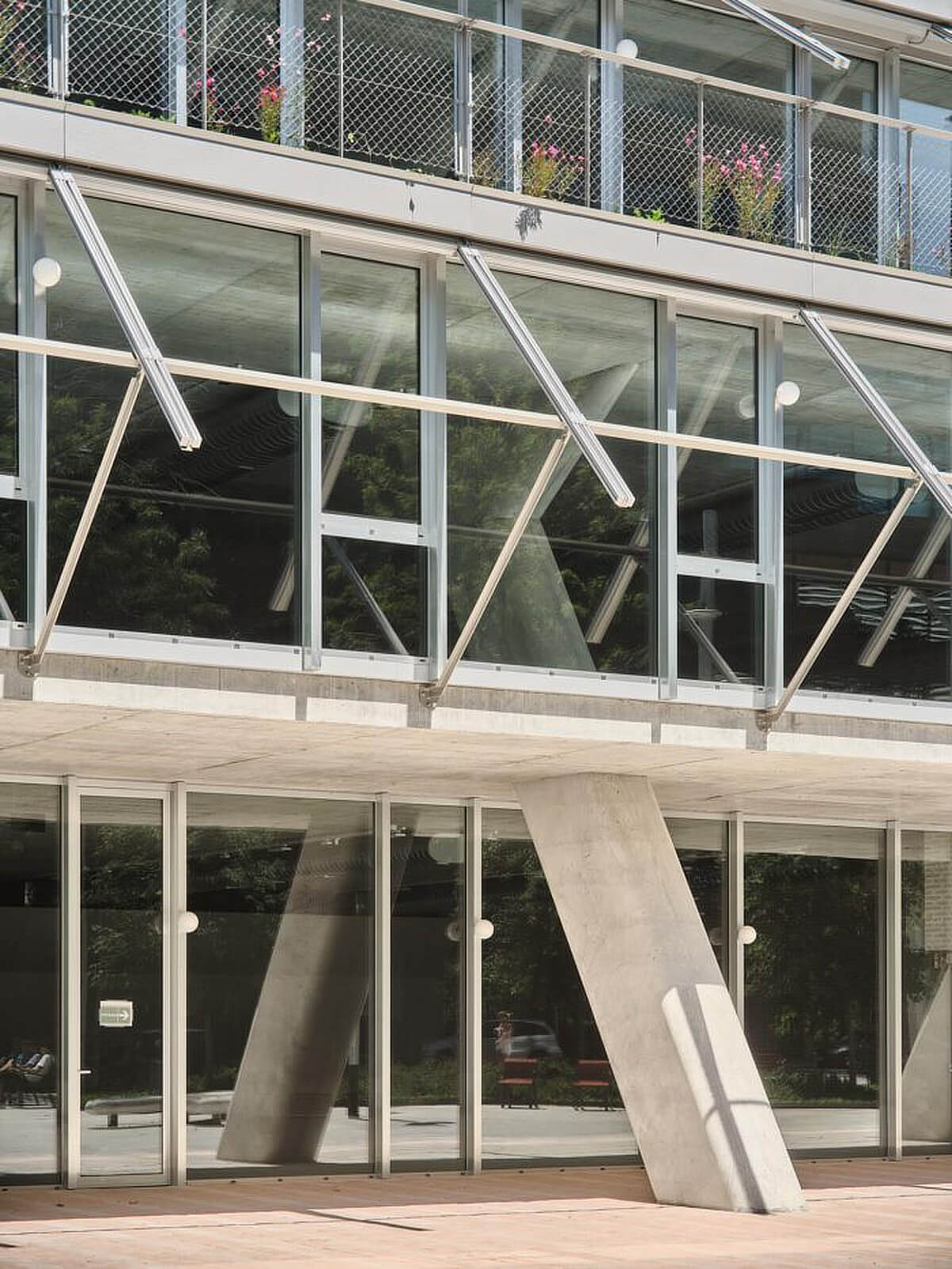
Llull 122 office building by BAAS Arquitectura, © Adrià Goula
The idea of the pillars can be reminiscent of Archigram’s megastructures or High-Tech projects, such as the neighboring Richard Rogers’ Hotel Hyatt Regency Barcelona Tower (2006) in L’Hospitalet de Llobregat, although the tilt in that building is less apparent. It is interesting to note that the proposal also recalls other British-designed buildings due to the combination of form and materials, specifically the stepped blocks of exposed concrete at the Brunswick Centre in London (1972), a Brutalist work by Patrick Hodgkinson. Even the presence of exposed brick walls, used here as a link to the neighborhood’s industrial architecture, also connects with the brutalist aesthetic, in this case that of James Stirling or the early projects of Alison & Peter Smithson.
The large columns are not only a structural and aesthetic leitmotif for the building; they are the only supporting elements within the floor plans, allowing for the large, open, and flexible spaces intended for offices. A system of awnings acts as supplementary solar protection on the main façade, since the concrete slabs do not project that much over the glazed enclosures. The side façade is defined by a series of large vertical concrete sunshades.
The project also incorporates other bioclimatic strategies, such as eliminating suspended ceilings and using natural ventilation systems enabled by automated high windows on the side façades.
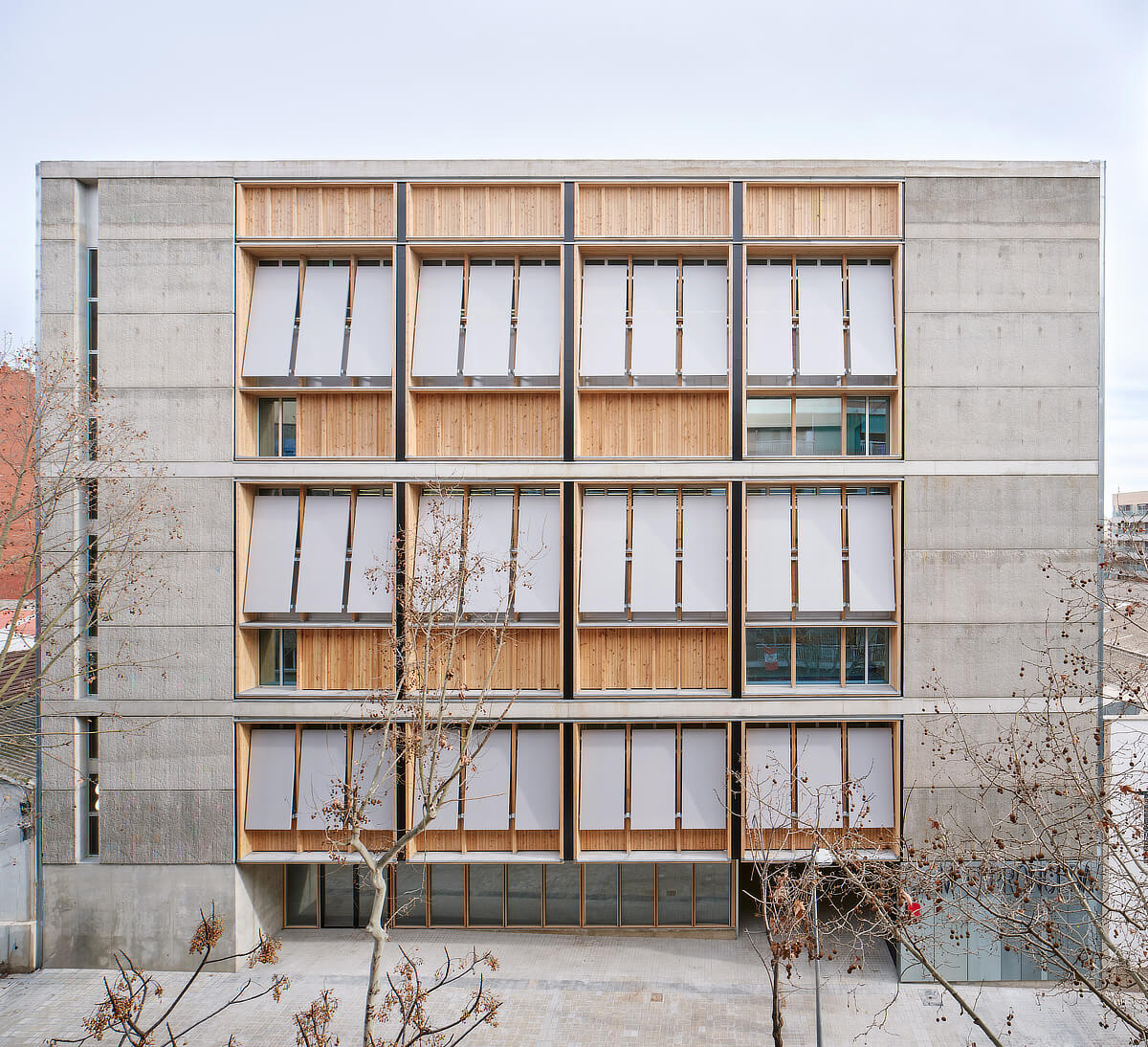
Espronceda Municipal Sports Complex by Conxita Balcells Associats and Barceló-Balanzó Arquitectes, © José Hevia
Espronceda Municipal Sports Center by Conxita Balcells Associats + Barceló-Balanzó Arquitectes
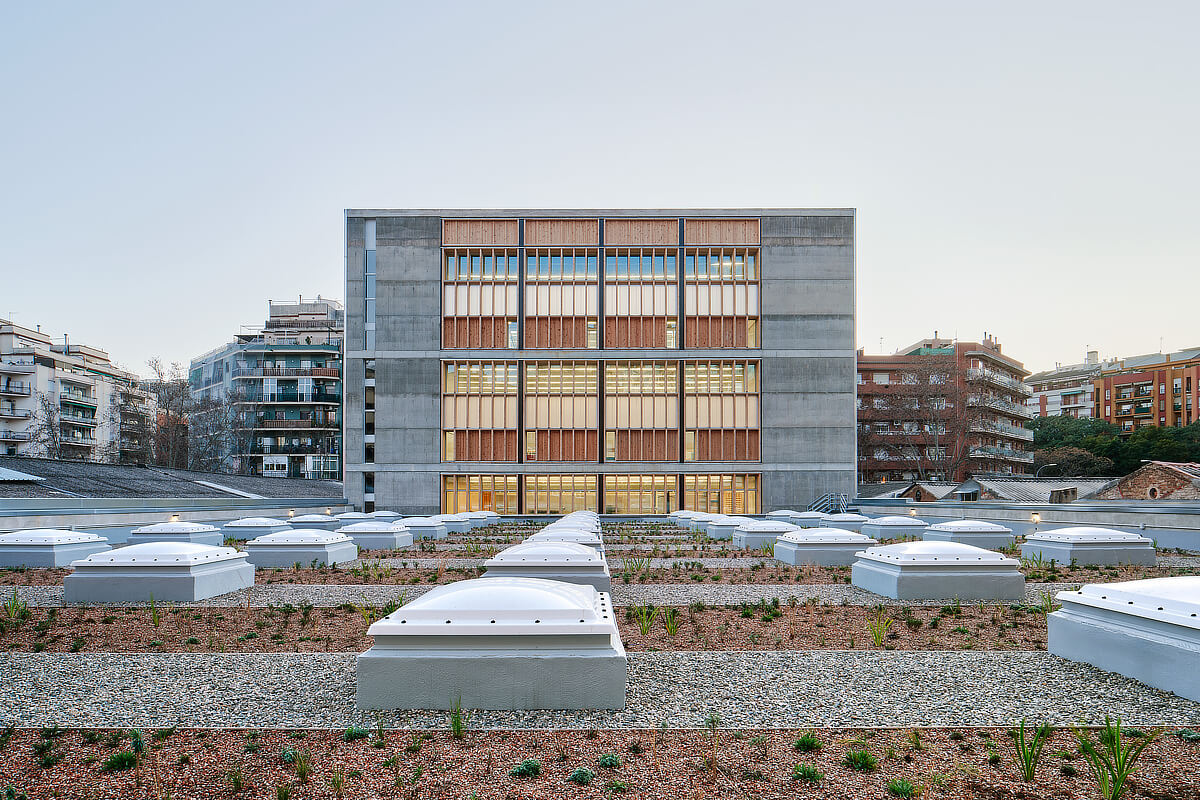
Continuing with urban facilities, another finalist is the Espronceda Municipal Sports Center (CEM), a work by Barceló-Balanzó Arquitectes and Conxita Balcells Associats. Situated between party walls, the volumetric design is very distinct, with a vertical rectangular prism aligned with Espronceda Street, connected to a horizontal one that extends almost to the back of the lot. The main facade emphasizes its hierarchy as a neighborhood facility and as a landmark building.
Because of its functional, tectonic, and even aesthetic approach, it seems to connect with the design tradition of Louis Kahn. The main volume is divided vertically in three, with the side wings housing the servant spaces such as locker rooms, storage rooms, and stairwells. The central block is primarily occupied by the large sports halls, characterized by their flexibility and great height, which would be the served spaces.
Each is expressed on the facade with different materials and levels of openness; the side volumes through exposed concrete walls with few openings, and the central volume with large windows framed by a wood-dominated grid. The result is a distinctly contemporary facade, but with a sense of eurhythmy characteristic of the finest classicism, or of Kahn’s masterpieces like the Salk Institute in La Jolla (1965).
The permeability of the ground floor flows from the street inward, connecting to the horizontal block that houses sports courts for various disciplines in a single long-span hall. The roof design comprises large post-tensioned concrete beams, a series of skylights that provide natural daylight, and a rooftop garden. In addition to functional flexibility, another priority of the project has been energy efficiency, applying passive strategies, self-generation, and seasonal adaptation measures.
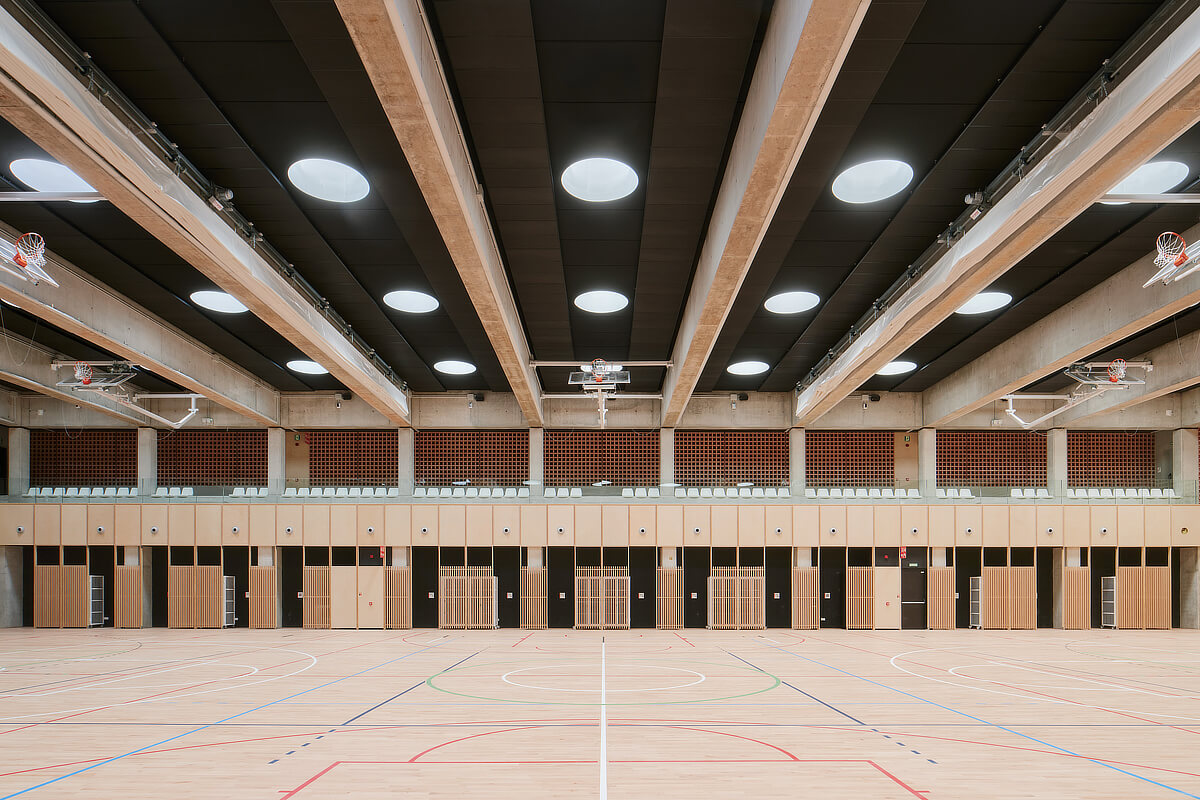
Espronceda Municipal Sports Complex by Conxita Balcells Associats and Barceló-Balanzó Arquitectes, © José Hevia
“Recirculate the Eixample” by Flexoarquitectura + Addenda Architects
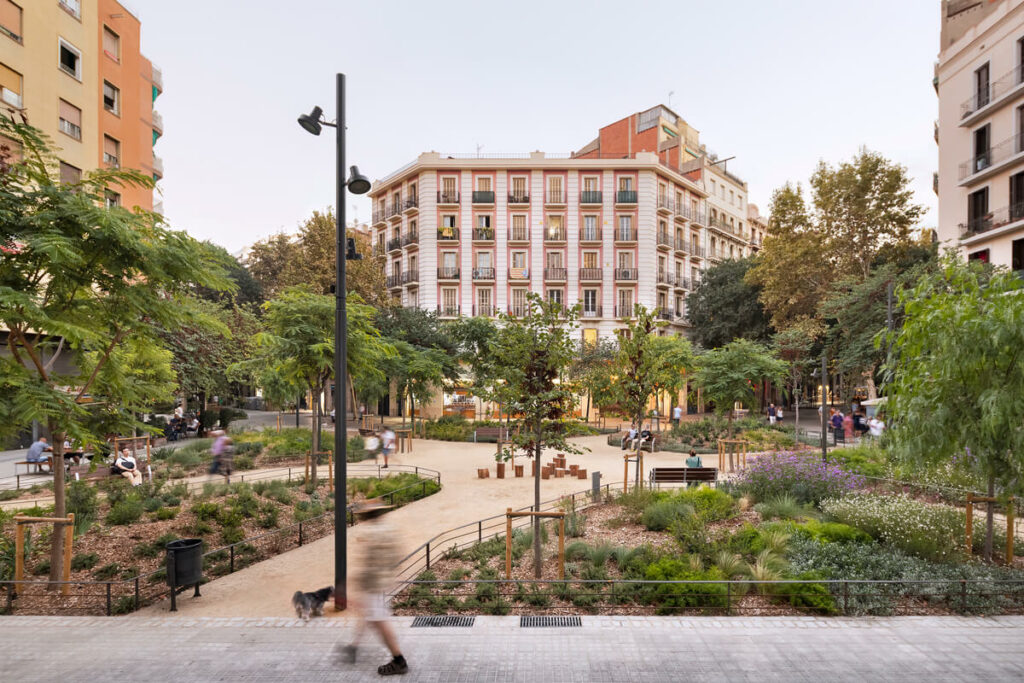
The last Barcelona finalist is a somewhat different and perhaps more complex project than the others. The “Recirculate the Eixample” proposal, developed by the teams from Flexoarquitectura and Addenda Architects, is an urban-scale intervention that involves the transformation of a block in the Eixample district, near the Sagrada Familia, where several facility buildings already existed. The proposal is reminiscent of other notable urban operations from recent decades, especially the intervention by RCR Arquitectes at the Sant Antoni–Joan Oliver Library and Cándida Pérez Gardens (2007).
Some of the buildings retain their previous function, such as the market or the library, while others are assigned new uses, such as the civic center, which now includes a children’s center and one for seniors. The two main premises of the renovation are sustainability and accessibility. Throughout the complex, energy efficiency has been improved by upgrading air conditioning systems or installing photovoltaic panels. On the other hand, urban permeability has been enhanced by improving the entrance points and the interconnection between the buildings and the block’s center courtyard. New public walkways, ramps, and accessible rooftops transform the urban dynamics of the complex. Finally, the intervention is used to improve the aesthetics of the components through materials, colors, and textures that seek to create a unified identity while respecting the pre-existing tectonic diversity.
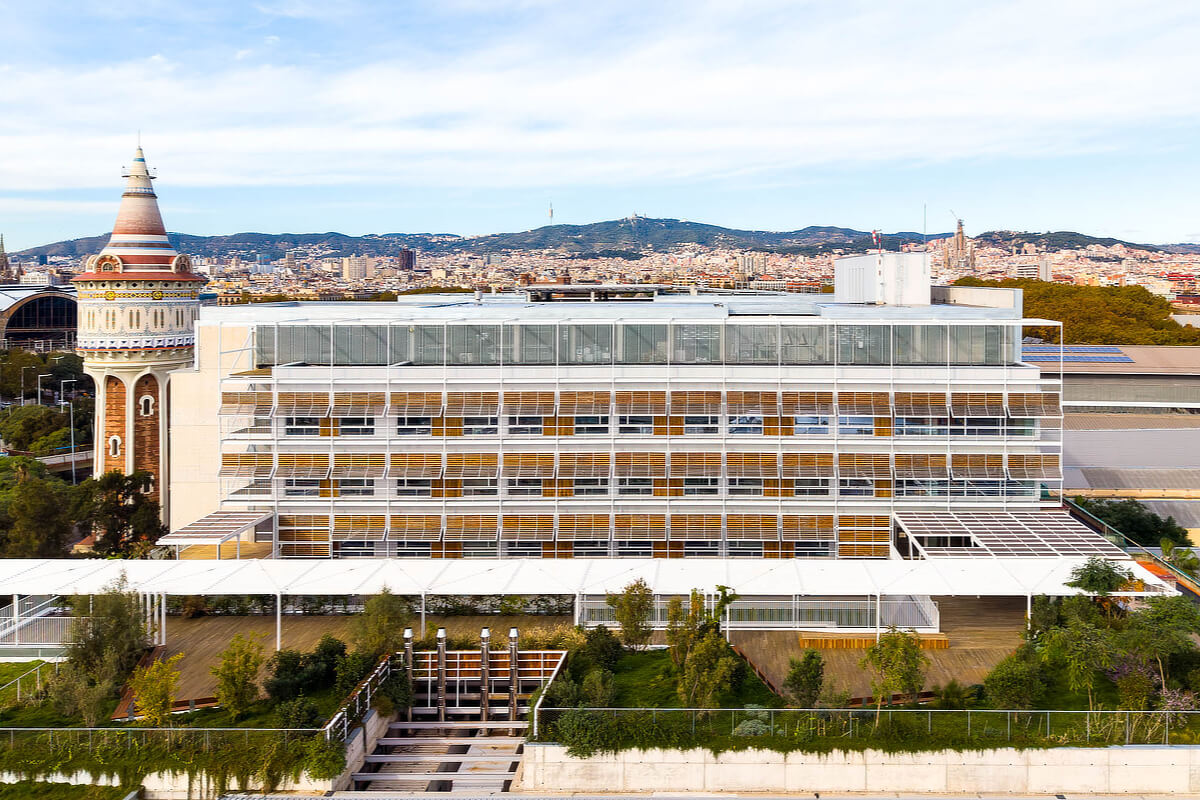
Hospital del Mar extension by Pinearq and Brullet de Luna, © Simón García
Nominations That Confirm Barcelona’s Contemporary Prominence
The FAD Architecture Awards have been, since their creation, a barometer and an incentive for local architectural creation. They have contributed to stimulating quality in design and construction and to consolidating the prominence of Spain and Barcelona on the international stage.
The local projects selected as finalists in the 2026 edition are predominantly public facilities and highlight the priorities of contemporary architecture: the integration of buildings with their urban settings, environmental sustainability, a commitment to serving the community, and functional adaptability. These priorities evidence the vitality of local production and the prominence of Barcelona’s architects.
The awards ceremony is scheduled for the afternoon of June 17, and we would like to wish all the finalists the best of luck.
Guiding Architects’ Thematic Itineraries on the FAD Awards
As part of the program of activities for Barcelona’s 2026 World Architecture Capital, Guiding Architects has organized two guided tours inspired by the FAD Architecture Awards, with the goal of promoting the history and significance of these awards and bringing the public closer to some of the most outstanding works of contemporary architecture in the city. The tours take place in two particularly significant urban areas: the upper part of the Diagonal Avenue and Les Corts on one hand, and the Poblenou district on the other.
Additionally, Guiding Architects Barcelona will also contribute to the awarding of the FAD International Prize, as our director, Lorenzo Kárász, has been invited to be part of the jury for that category. This award was created to recognize architectural excellence beyond the Iberian Peninsula and helps to spread the prestige of the FAD and its awards in other countries.
Text: Pedro Capriata
BIBLIOGRAPHY
Archello (s.f.). Hospital del Mar: espacios de salud abiertos al mar.
https://archello.com/es/project/phase-2-expansion-of-hospital-del-mar-in-barcelona
ARQUINFAD (s.f.). Premios FAD de Arquitectura e Interiorismo.
https://arquinfad.org/premisfad/es/edicion-en-curso/
Arquitectura Viva (1994). Hospital del Mar, Barcelona.
https://arquitecturaviva.com/obras/hospital-del-mar-barcelona
Arquitectura Viva (2025). Centro Deportivo Municipal Espronceda en Barcelona.
https://arquitecturaviva.com/obras/centro-deportivo-municipal-espronceda-en-barcelona
Arquitectura Viva (2025). Edificio de oficinas Llul 122 en Barcelona.
https://arquitecturaviva.com/obras/edificio-de-oficinas-llul-122-en-barcelona
Arquitectura Viva (2026). Recircular l’Eixample en Barcelona.
https://arquitecturaviva.com/obras/recircular-leixample-en-barcelona
Arquitectura Viva (2026). Finalistas de los Premios FAD 2026.
https://arquitecturaviva.com/articulos/finalistas-de-los-premios-fad-2026?utm_source=chatgpt.com
BAAS Arquitectura (s.f.). Llull Office Building.
https://baas.cat/archive/llull-office-building/
Barceló Balanzó Arquitectes (s.f.). Centro Deportivo Municipal Espronceda en el barrio de Navas.
https://www.bbarquitectes.com/es/work/centro-deportivo-municipal-espronceda-en-el-barrio-de-navas-en-barcelona/
Centre Obert d’Arquitectura (s.f.) ArquitecturaCatalana.Cat
https://www.arquitecturacatalana.cat/es
Flexo Arquitectura (s.f.). Sagrada Familia – Civic, Children’s, and Senior Centers.
https://flexoarquitectura.com/work/sagrada-familia
Frampton, K. (1992). Modern Architecture. A Critical History. Thames and Hudson.
London on the Ground (2024). The Brunswick Centre, a pioneer in 20th century architecture.
https://www.londonontheground.com/post/the-brunswick-centre-a-pioneer-in-20th-century-architecture
Pinearq (s.f.). Reforma y ampliación del Hospital del Mar.
https://pinearq.es/proyectos/arquitectura-hospitalaria/reforma-y-ampliacion-del-hospital-del-mar/
The FAD Architecture Awards 2026
Several Projects Located in Barcelona Have Been Selected as Finalists for the FAD Architecture Awards
Hospital del Mar extension by Pinearq and Brullet de Luna, © Simón García
The FAD, an Institution With a History
The FAD, whose initials originally stood for Fomento de las Artes Decorativas (Promotion of Decorative Arts), was founded in Barcelona in 1903 as a professional association of artisans and decorative artists. It had an active history in its first decades, participating, for example, in the creation of the Massana School in 1929. But it was in 1958, with the creation of the FAD Architecture Award, that the association’s cultural relevance took a significant leap. The new award, which had Oriol Bohigas as one of its main founders, aimed to promote modern architecture, and especially buildings related to the Grup R, as opposed to the predominant architecture of the time, which had vernacular and conservative tendencies.
The first architects to receive it were Guillem Giráldez, Pedro López Iñigo, and Xavier Subías, for their project for the Faculty of Law, a work with openly rationalist features, designed and built in a surprising record time of 12 months. Over time, the FAD awards went from being a local prize to becoming the most prestigious award given in the Iberian Peninsula.
Llull 122 office building by BAAS Arquitectura, © Adrià Goula
The FAD Awards Enter a New Phase
The most important change in the organization and awarding of the prizes since their foundation occurred in 2006, when the FAD was renamed Fomento de las Artes y el Diseño (Promotion of Arts and Design), retaining its traditional Spanish acronym. It was at that time that the current categories of the Architecture and Interior Design Awards were established: Architecture, Interior Design, City and Landscape, Ephemeral Interventions, and Reflection and Criticism. Currently, the FAD is subdivided according to the various professional areas related to design. ARQUIN-FAD is the association corresponding to the fields of architecture, urban planning, landscape architecture, and interior design, and is therefore the direct responsible for the aforementioned awards.
The call for entries for these awards is open to projects from the Iberian Peninsula and is held annually. ARQUIN-FAD is responsible for appointing a jury made up of prestigious architects, university professors, critics, and other specialists, aiming to include a diversity of profiles. In the first stage, the jury conducts a preliminary selection of projects and then compiles a list of finalists. The projects that reach this phase are analyzed in greater detail and depth, and are also visited by the jury members before the final decision is made and the winner is announced.
Espronceda Municipal Sports Complex by Conxita Balcells Associats and Barceló-Balanzó Arquitectes, © José Hevia
The Current Edition: 2026 Finalist Projects
The list of finalists for the 2026 edition has highlighted an interesting collection of recent buildings, all of them of high quality, including several projects located in Barcelona. The category in which the local works stand out the most is City and Landscape, as two of the four finalists are in the Catalan capital. These are the Open Spaces at the Illa Diagonal by Batlleiroig Arquitectura and the final phase of the Parc de les Glòries, identified as “Urban Canopy – Tunnels Area,” by Agence TER and Ana Coello. Coincidentally, it’s a project featured in the latest Guiding Architects Barcelona blog post.
In the Architecture category, 15 finalists have been selected, four of which are located in Barcelona. This is also a considerable percentage, considering that the finalists are spread across Spain and Portugal. It’s a good opportunity to take an interest in these four projects, which join the long list of local buildings worth visiting.
Hospital del Mar extension by Pinearq and Brullet de Luna, © Simón García
The Expansion of the Hospital Del Mar by Pinearq + Brullet de Luna
The new expansion of Hospital del Mar (Phase 2) is the latest chapter in a long history of renovations and projects carried out by the Pinearq and Brullet de Luna teams at the historic healthcare complex and its surroundings. These architects were responsible for the first major transformation of this facility, located in a prime setting, when it was proposed to serve as the Olympic hospital in 1992. That prestigious and influencial proposal was followed in 2007 by the Parc de Recerca Biomèdica, a complementary project adjacent to the hospital, featured on our blog about Scientific Research Buildings in Barcelona, and then in 2017 by the hospital’s first expansion. The recent project culminates the urban and functional transformation of a significant section of Barcelona’s waterfront.
The new building is a U-shaped block open onto Gas Street, primarily housing inpatient rooms, and is connected to the rest of the complex by a two-story horizontal volume. A metal grid is set in front of the elevated facades, framing an elegant system of wooden shutters. Aesthetically, the blinds connect the building with local tradition but also to the Parc de Recerca Biomèdica. Functionally, the shutters provide privacy to the rooms and protect the facades from excessive sun.
Facing the waterfront, the new block opens onto an attractive landscaped terrace on the third floor, designed for the relaxation of patients and medical staff, but which also enhances the hospital’s environmental performance. Sustainability criteria are also reflected in the use of certified wood, locally sourced materials, and rainwater recycling.
Llull 122 office building by BAAS Arquitectura, © Adrià Goula
The Llull 122 Building by Baas Arquitectura
The Llull 122 office building, designed by BAAS Arquitectura, is strategically located on a corner of the 22@ district in the Poblenou neighborhood.
At first glance, two features of the building stand out: its stepped volume and its modified alignment to create a public plaza. The resulting space functions as an outdoor foyer, creating a dynamic relationship with the surroundings, reinforced by the building’s permeability on the ground floor.
The scale and configuration of the volume give the project a friendly character toward both the city and the user, creating a sequence of landscaped terraces that contrast with the exposed concrete, which is the predominant material. The two inclined pillars accompany the building’s stepped shape forming a porch as they project over the plaza.
Llull 122 office building by BAAS Arquitectura, © Adrià Goula
The idea of the pillars can be reminiscent of Archigram’s megastructures or High-Tech projects, such as the neighboring Richard Rogers’ Hotel Hyatt Regency Barcelona Tower (2006) in L’Hospitalet de Llobregat, although the tilt in that building is less apparent. It is interesting to note that the proposal also recalls other British-designed buildings due to the combination of form and materials, specifically the stepped blocks of exposed concrete at the Brunswick Centre in London (1972), a Brutalist work by Patrick Hodgkinson. Even the presence of exposed brick walls, used here as a link to the neighborhood’s industrial architecture, also connects with the brutalist aesthetic, in this case that of James Stirling or the early projects of Alison & Peter Smithson.
The large columns are not only a structural and aesthetic leitmotif for the building; they are the only supporting elements within the floor plans, allowing for the large, open, and flexible spaces intended for offices. A system of awnings acts as supplementary solar protection on the main façade, since the concrete slabs do not project that much over the glazed enclosures. The side façade is defined by a series of large vertical concrete sunshades.
The project also incorporates other bioclimatic strategies, such as eliminating suspended ceilings and using natural ventilation systems enabled by automated high windows on the side façades.
Espronceda Municipal Sports Complex by Conxita Balcells Associats and Barceló-Balanzó Arquitectes, © José Hevia
Espronceda Municipal Sports Center by Conxita Balcells Associats + Barceló-Balanzó Arquitectes
Continuing with urban facilities, another finalist is the Espronceda Municipal Sports Center (CEM), a work by Barceló-Balanzó Arquitectes and Conxita Balcells Associats. Situated between party walls, the volumetric design is very distinct, with a vertical rectangular prism aligned with Espronceda Street, connected to a horizontal one that extends almost to the back of the lot. The main facade emphasizes its hierarchy as a neighborhood facility and as a landmark building.
Because of its functional, tectonic, and even aesthetic approach, it seems to connect with the design tradition of Louis Kahn. The main volume is divided vertically in three, with the side wings housing the servant spaces such as locker rooms, storage rooms, and stairwells. The central block is primarily occupied by the large sports halls, characterized by their flexibility and great height, which would be the served spaces.
Each is expressed on the facade with different materials and levels of openness; the side volumes through exposed concrete walls with few openings, and the central volume with large windows framed by a wood-dominated grid. The result is a distinctly contemporary facade, but with a sense of eurhythmy characteristic of the finest classicism, or of Kahn’s masterpieces like the Salk Institute in La Jolla (1965).
The permeability of the ground floor flows from the street inward, connecting to the horizontal block that houses sports courts for various disciplines in a single long-span hall. The roof design comprises large post-tensioned concrete beams, a series of skylights that provide natural daylight, and a rooftop garden. In addition to functional flexibility, another priority of the project has been energy efficiency, applying passive strategies, self-generation, and seasonal adaptation measures.
Espronceda Municipal Sports Complex by Conxita Balcells Associats and Barceló-Balanzó Arquitectes, © José Hevia
“Recirculate the Eixample” by Flexoarquitectura + Addenda Architects
The last Barcelona finalist is a somewhat different and perhaps more complex project than the others. The “Recirculate the Eixample” proposal, developed by the teams from Flexoarquitectura and Addenda Architects, is an urban-scale intervention that involves the transformation of a block in the Eixample district, near the Sagrada Familia, where several facility buildings already existed. The proposal is reminiscent of other notable urban operations from recent decades, especially the intervention by RCR Arquitectes at the Sant Antoni–Joan Oliver Library and Cándida Pérez Gardens (2007).
Some of the buildings retain their previous function, such as the market or the library, while others are assigned new uses, such as the civic center, which now includes a children’s center and one for seniors. The two main premises of the renovation are sustainability and accessibility. Throughout the complex, energy efficiency has been improved by upgrading air conditioning systems or installing photovoltaic panels. On the other hand, urban permeability has been enhanced by improving the entrance points and the interconnection between the buildings and the block’s center courtyard. New public walkways, ramps, and accessible rooftops transform the urban dynamics of the complex. Finally, the intervention is used to improve the aesthetics of the components through materials, colors, and textures that seek to create a unified identity while respecting the pre-existing tectonic diversity.
Hospital del Mar extension by Pinearq and Brullet de Luna, © Simón García
Nominations That Confirm Barcelona’s Contemporary Prominence
The FAD Architecture Awards have been, since their creation, a barometer and an incentive for local architectural creation. They have contributed to stimulating quality in design and construction and to consolidating the prominence of Spain and Barcelona on the international stage.
The local projects selected as finalists in the 2026 edition are predominantly public facilities and highlight the priorities of contemporary architecture: the integration of buildings with their urban settings, environmental sustainability, a commitment to serving the community, and functional adaptability. These priorities evidence the vitality of local production and the prominence of Barcelona’s architects.
The awards ceremony is scheduled for the afternoon of June 17, and we would like to wish all the finalists the best of luck.
Guiding Architects’ Thematic Itineraries on the FAD Awards
As part of the program of activities for Barcelona’s 2026 World Architecture Capital, Guiding Architects has organized two guided tours inspired by the FAD Architecture Awards, with the goal of promoting the history and significance of these awards and bringing the public closer to some of the most outstanding works of contemporary architecture in the city. The tours take place in two particularly significant urban areas: the upper part of the Diagonal Avenue and Les Corts on one hand, and the Poblenou district on the other.
Additionally, Guiding Architects Barcelona will also contribute to the awarding of the FAD International Prize, as our director, Lorenzo Kárász, has been invited to be part of the jury for that category. This award was created to recognize architectural excellence beyond the Iberian Peninsula and helps to spread the prestige of the FAD and its awards in other countries.
Text: Pedro Capriata
BIBLIOGRAPHY
Archello (s.f.). Hospital del Mar: espacios de salud abiertos al mar.
https://archello.com/es/project/phase-2-expansion-of-hospital-del-mar-in-barcelona
ARQUINFAD (s.f.). Premios FAD de Arquitectura e Interiorismo.
https://arquinfad.org/premisfad/es/edicion-en-curso/
Arquitectura Viva (1994). Hospital del Mar, Barcelona.
https://arquitecturaviva.com/obras/hospital-del-mar-barcelona
Arquitectura Viva (2025). Centro Deportivo Municipal Espronceda en Barcelona.
https://arquitecturaviva.com/obras/centro-deportivo-municipal-espronceda-en-barcelona
Arquitectura Viva (2025). Edificio de oficinas Llul 122 en Barcelona.
https://arquitecturaviva.com/obras/edificio-de-oficinas-llul-122-en-barcelona
Arquitectura Viva (2026). Recircular l’Eixample en Barcelona.
https://arquitecturaviva.com/obras/recircular-leixample-en-barcelona
Arquitectura Viva (2026). Finalistas de los Premios FAD 2026.
https://arquitecturaviva.com/articulos/finalistas-de-los-premios-fad-2026?utm_source=chatgpt.com
BAAS Arquitectura (s.f.). Llull Office Building.
https://baas.cat/archive/llull-office-building/
Barceló Balanzó Arquitectes (s.f.). Centro Deportivo Municipal Espronceda en el barrio de Navas.
https://www.bbarquitectes.com/es/work/centro-deportivo-municipal-espronceda-en-el-barrio-de-navas-en-barcelona/
Centre Obert d’Arquitectura (s.f.) ArquitecturaCatalana.Cat
https://www.arquitecturacatalana.cat/es
Flexo Arquitectura (s.f.). Sagrada Familia – Civic, Children’s, and Senior Centers.
https://flexoarquitectura.com/work/sagrada-familia
Frampton, K. (1992). Modern Architecture. A Critical History. Thames and Hudson.
London on the Ground (2024). The Brunswick Centre, a pioneer in 20th century architecture.
https://www.londonontheground.com/post/the-brunswick-centre-a-pioneer-in-20th-century-architecture
Pinearq (s.f.). Reforma y ampliación del Hospital del Mar.
https://pinearq.es/proyectos/arquitectura-hospitalaria/reforma-y-ampliacion-del-hospital-del-mar/
Related Posts
30.06.2026
From a Landmark Public Library to Industrial Heritage Sites and FAD Award-Recognised Works.

11.05.2026
Barcelona Is Replacing Paved Areas Such as Intersections and Inner-Block Spaces With New Green Areas, Fostering Urban Ecological Regeneration.
23.03.2026
Barcelona Is Committed to Repurposing Roads and Paved Urban Spaces to Increase Green Surface and Prioritize Pedestrians.
16.02.2026
Barcelona, World Capital of Architecture, Kicks off a Unique Year – And We Invite You to Experience the City With Us.