Barcelona Celebrates the Gaudí Year 2026 With an Exciting Program of Activities
Exhibitions, Academic Events, Projections and Concerts Will Fill Barcelona to Commemorate the Centenary of Antoni Gaudí’s Death
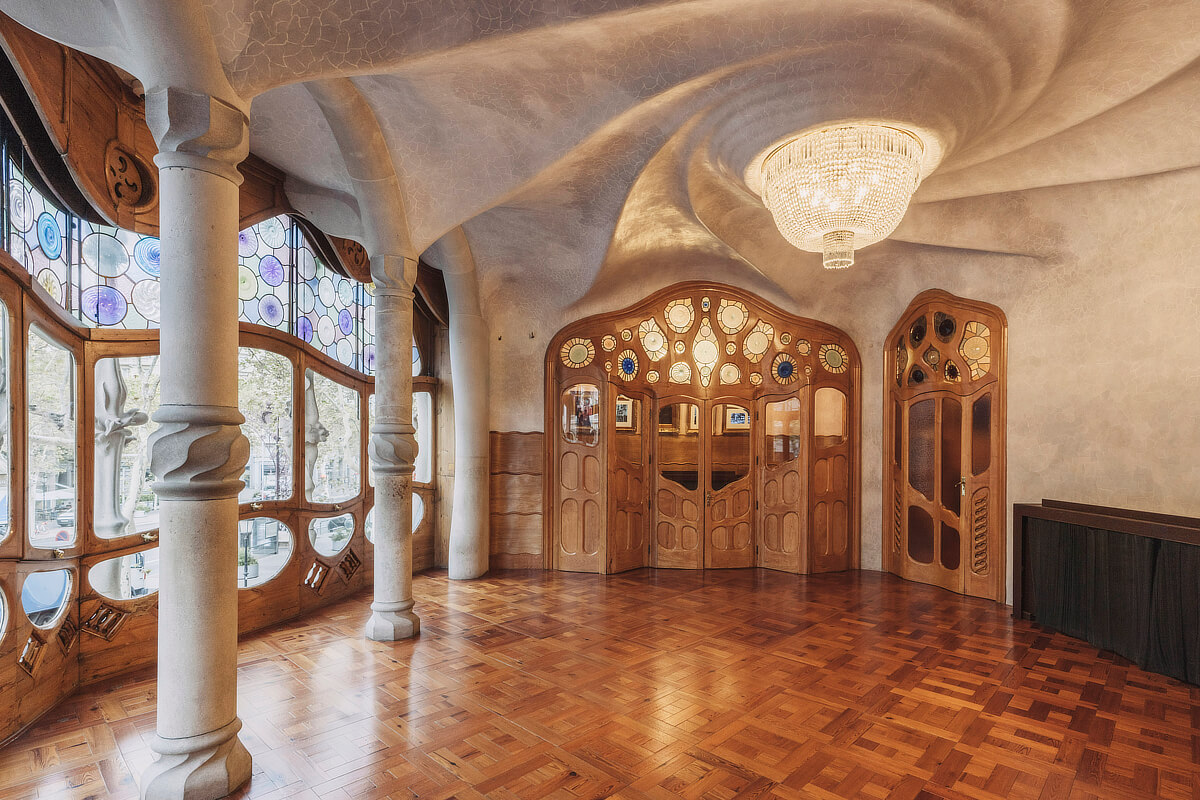
Noble floor of Casa Batlló, courtesy of Casa Batlló
The Gaudí Year Takes Center Stage in Barcelona’s World Capital Role
In 2026, Barcelona will assume the status of World Capital of Architecture and will host numerous exhibitions, conferences, and events, including those planned to commemorate the Gaudí Year, marking the 100th anniversary of his death.
To celebrate the jubilee, a wide range of educational and academic activities, itineraries, and even concerts have been planned, dedicated to highlighting the legacy of Catalonia’s most international architect. Although the events mentioned will take place in various locations such as Mataró, Reus, Palma de Mallorca, and Comillas, Barcelona will clearly be the epicenter of the Gaudí Year, offering a unique opportunity to rediscover the work of this singular and visionary creator.
Antoni Gaudí’s architecture has fascinated generations of architects and enthusiasts due to its formal richness, symbolic complexity, and technical innovations. For those who are not very familiar with it, a brief introduction can be found in a previous Guiding Architects article: Antoni Gaudí and Contemporary Architecture. For a more detailed survey of the subject, some recommended reading is included at the end of this article.
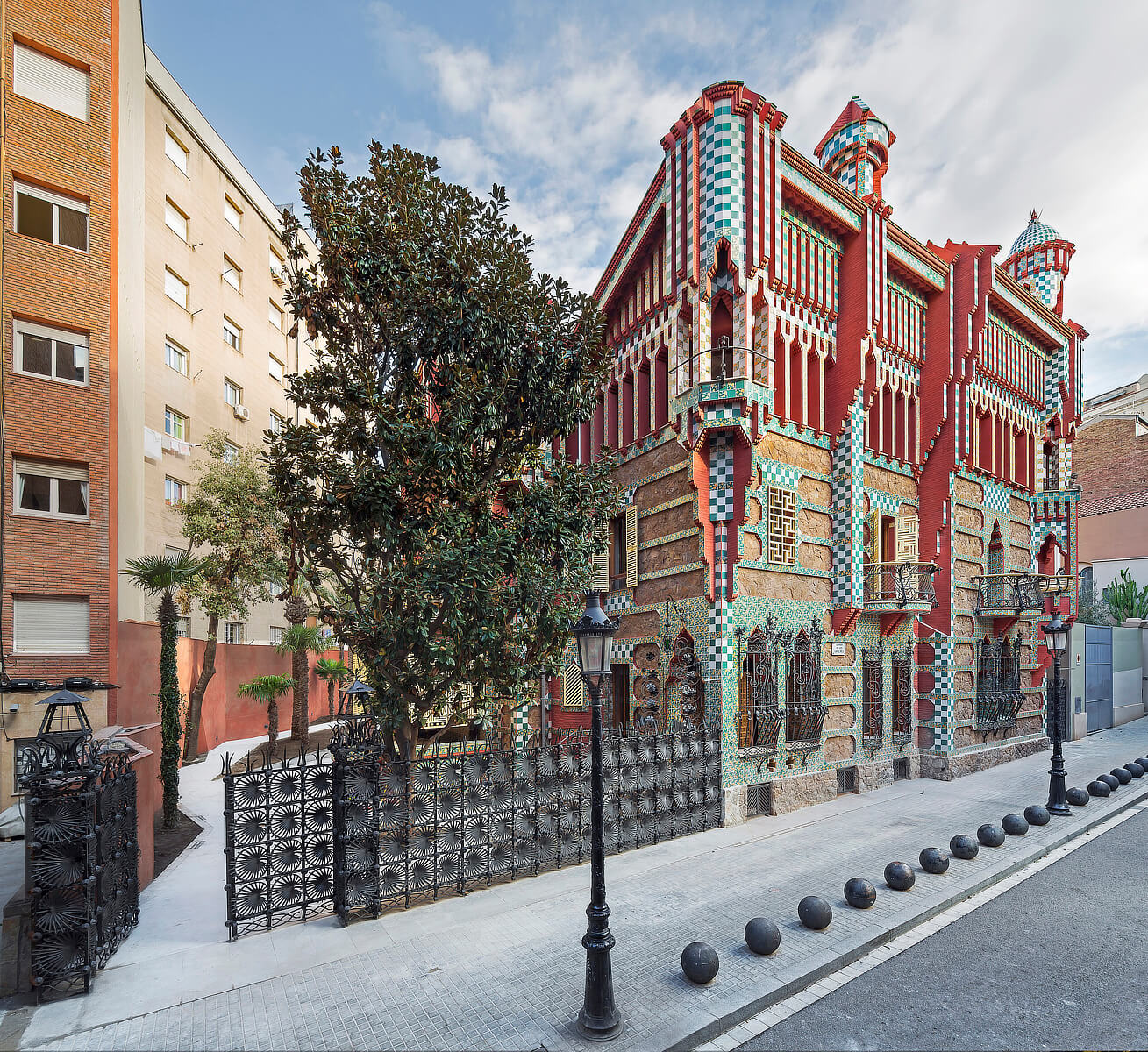
Casa Vicens, © Pol Viladoms, licensed under CC BY-SA 4.0
Tradition and Restoration at the Vicens House
The Vicens House, Gaudí’s first major work, has only been open to the public for a few years compared to other buildings. However, it has established itself as an essential visit for fans of the architect and is joining in the commemoration with two main events.
The first has more to do with local tradition, but it can be an opportunity to see the building in a new light. It is the feast day of Saint Rita, patron saint of impossible causes, which has been celebrated at this location every May 22nd for more than 200 years.
The origin of this ritual is said to be linked to a fountain, now disappeared, whose waters were believed to have healing and even miraculous properties. In honor of Saint Rita, the gardens and terraces will be filled with roses that will then be blessed, following a custom that is particularly rooted in the Gracia neighborhood.
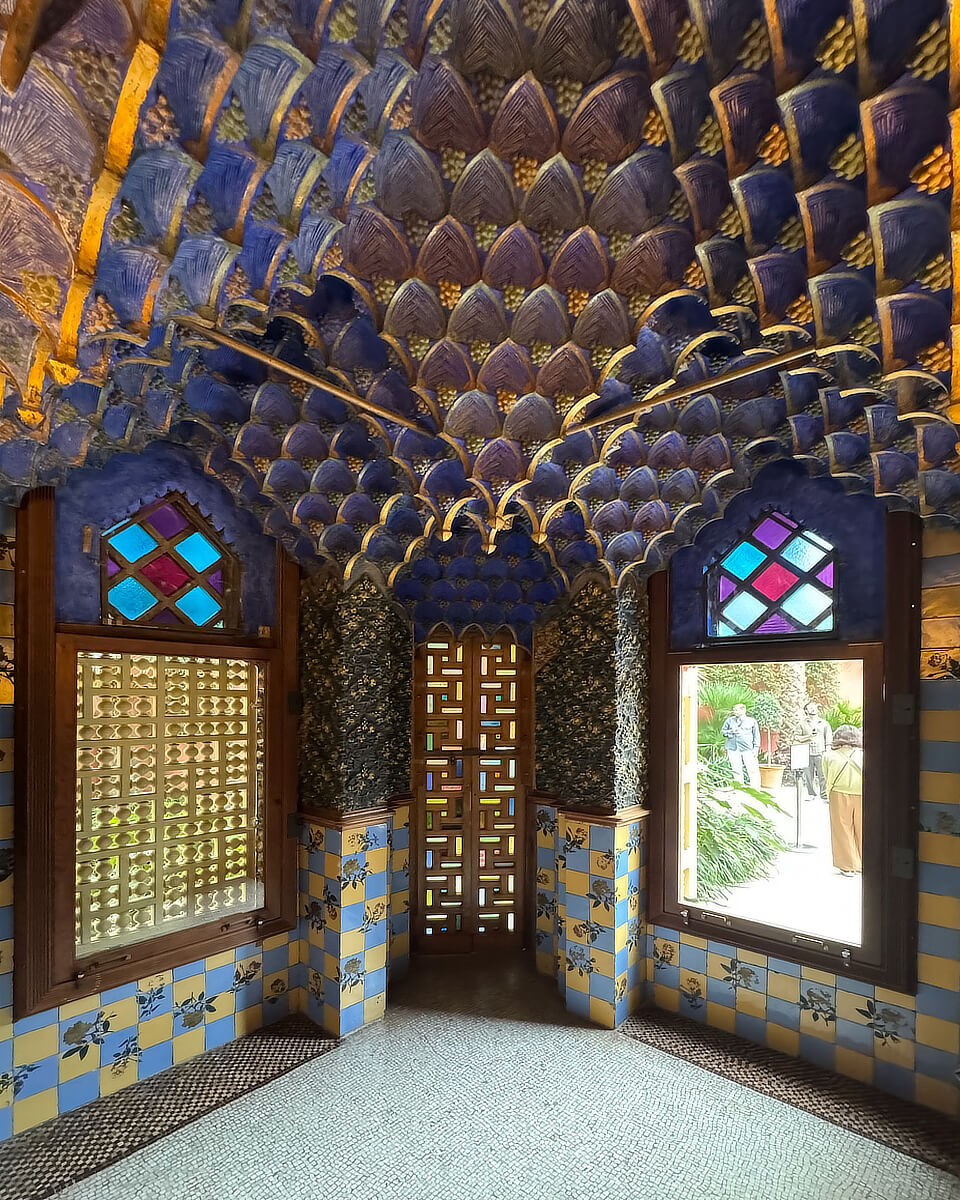
Smoking room at Casa Vicens, courtesy of Architekturzentrum Wien
From an architectural point of view, the restoration of the smoking room, scheduled for completion in November, will be even more interesting. This room is one of the most unique spaces in the house for many reasons, starting with its ornate Orientalist decoration and certain technical aspects.
Smoking rooms were popular in the last decades of the 19th century in various European countries. They can be found, for example, in Victor Horta’s projects in Brussels, such as the Tassel House (1894) and the Solvay House (1900). Tradition linked tobacco with the East, from where it was usually imported, so the choice of theme was not particularly surprising. What was surprising was the decision to use certain components, such as the muqarnas on the ceiling, inspired by the Alhambra in Granada, or the innovative papier-mâché tiles used to cover the walls.
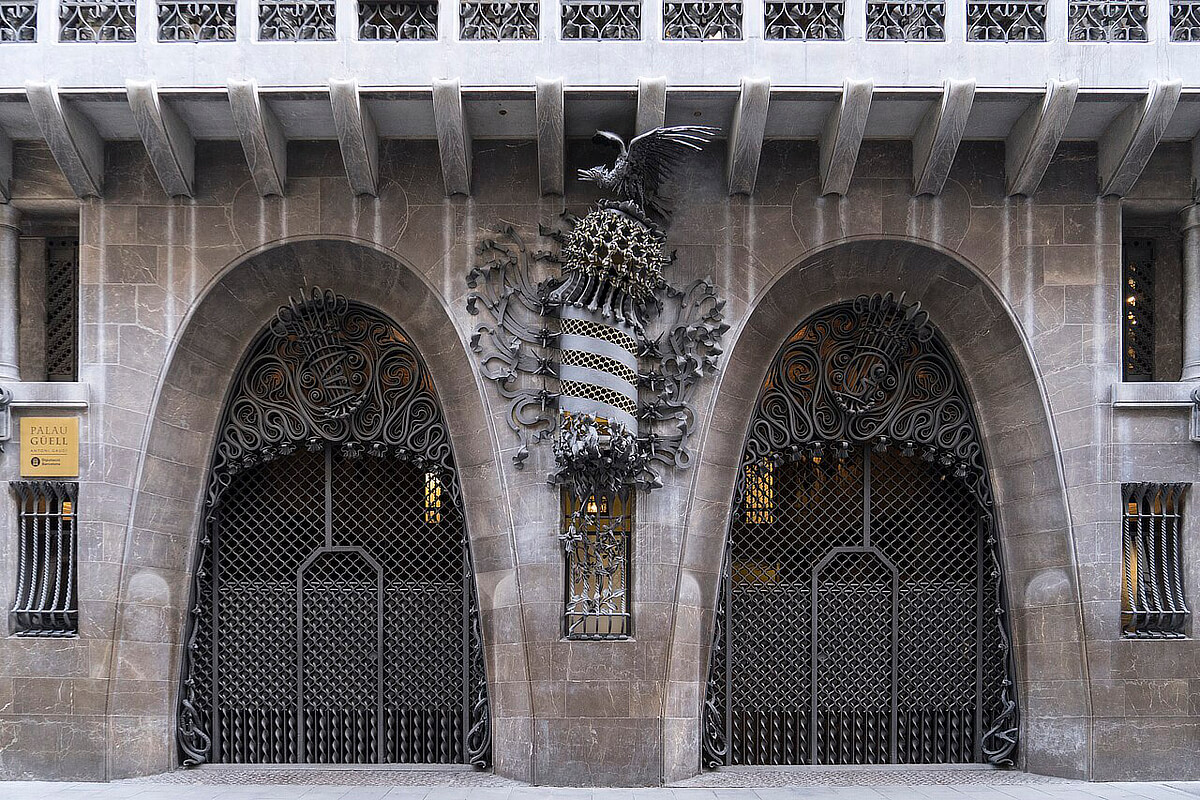
Entrance of Palau Güell, © Thomas Ledl, licensed under CC BY-SA 4.0
The Universe of Gaudí in an Attractive Set of Exhibitions at Various Venues
Exhibitions on Gaudí and his work will be an important part of the program of activities. The Museu Nacional d’Art de Catalunya, for example, is presenting Gaudí and His Contemporaries, a series of themed virtual tours in the form of digital micro-stories. It will also incorporate previously unseen works by Gaudí and others into its permanent collection under the title More Gaudí, Reflections and Analogies.
Meanwhile, a temporary exhibition at the Museu d’Història de Catalunya offers an ambitious overview of Gaudí’s entire oeuvre, explaining both the architectural principles applied and their relationship to the historical, social, and technological context. The Palau Güell will also join the occurrence, hosting two other exhibitions with much more specific themes.
The first, entitled Gaudí, Windows to the Future, revolves around the openings in his work. Unique doors, windows, and stained glass are the material expression of new ways of understanding the use of light, the relationship between interior and exterior, and the connection between spaces. The second, Francesc Vidal i Jevellí at the Palau Güell, will focus on the furniture created specifically for this residence with the participation of cabinetmaker Vidal.
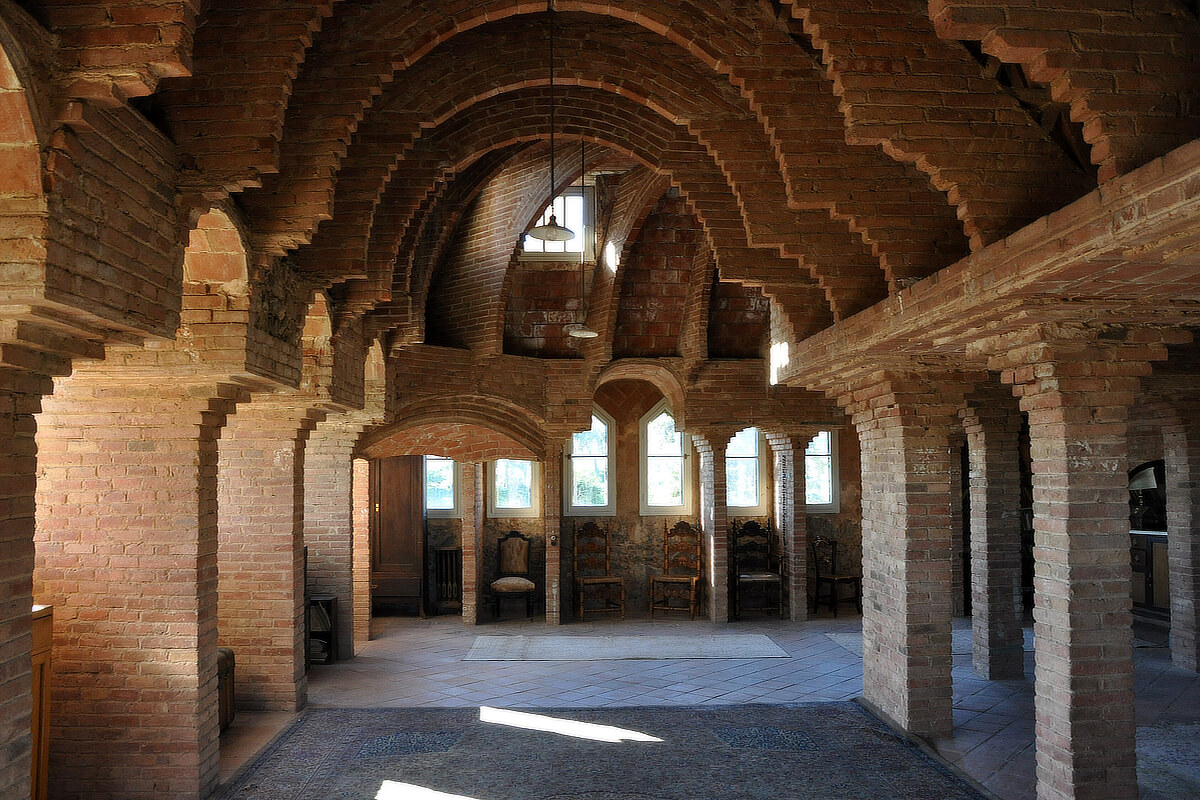
Sala de Maons at Torre Bellesguard, © Josep Bracons, licensed under CC BY-SA 2.0
Presentation of a Monograph and Concert at Torre Bellesguard
The activities of the Gaudí Year will also provide an opportunity to visit buildings not always accessible or lesser-known, such as the Figueras House, better known as Torre Bellesguard (1909), located in the upper part of Barcelona. The house takes its name from a castle that once stood on the site and is said to have belonged to King Martí the Humane.
The project is based on a square prism with added elements and, perhaps due to a desire to connect with history, seems particularly influenced by Gothic architecture. But as is usual in the architect’s work, to say that it is a neo-Gothic building would be an understatement. Both its structural brick arches and its decorative details unmistakably identify it as a Gaudí work.
This year, the building will host the presentation of the first monograph dedicated to it, written by Galdric Santana, current director of the Gaudí Chair. There will also be an opportunity to attend concerts by the renowned conductor and cellist Jordi Savall at Bellesguard, with a program dedicated to the architect.
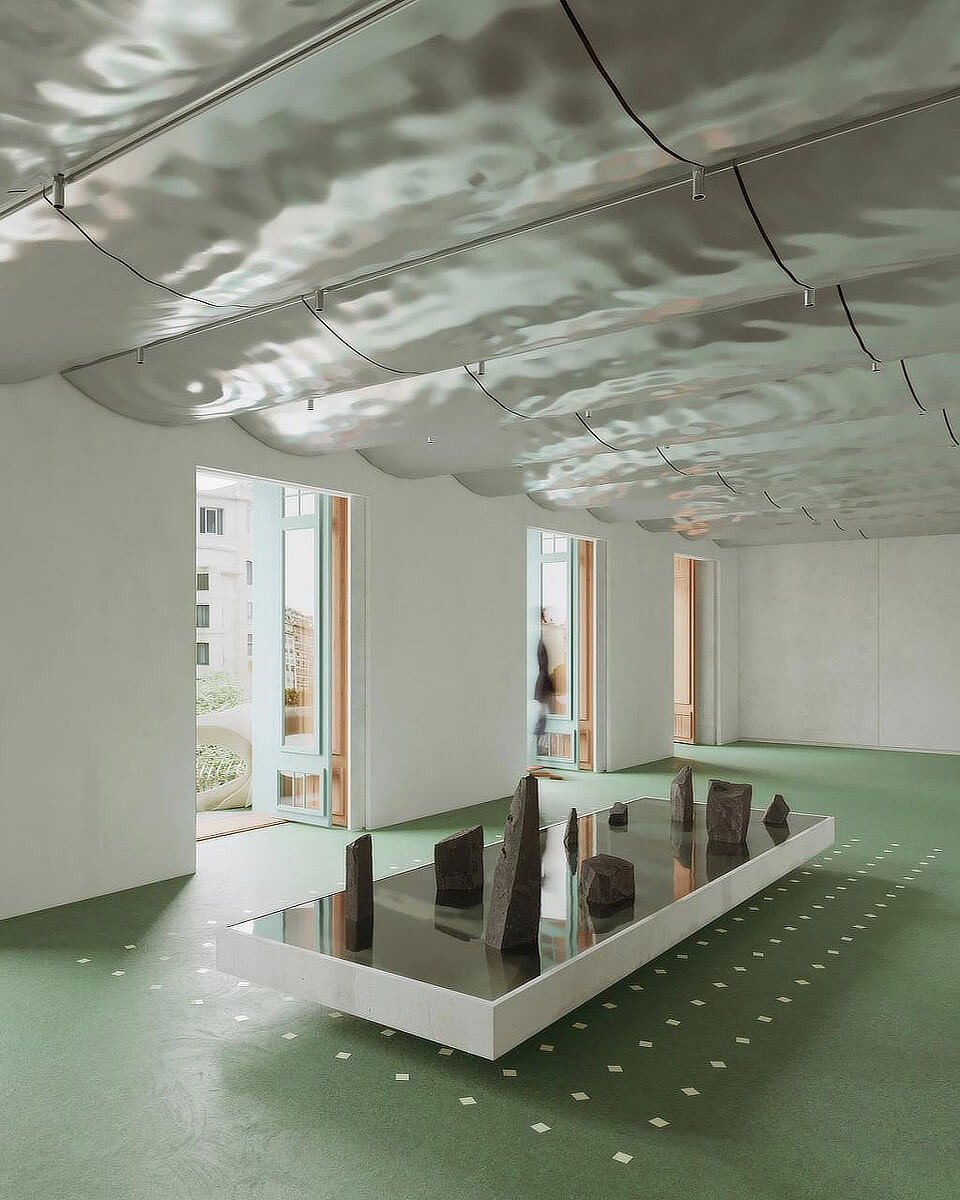
New exhibition space at Casa Batlló by Mesura, © ethandeclerk
Newly Accessible Space in the Batlló House
The iconic Batlló House will also play a leading role in the celebrations. The inauguration of a new exhibition space located on the second floor, a level that until now could not be visited, stands out from an architectural perspective. The renovation, carried out by the Barcelona-based studio Mesura, carefully restores historical elements such as the woodwork, but also creates new ones such as the flooring and a distinctive false ceiling made of screen-printed metal pieces reminiscent of an inverted revoltó, a traditional local vaulting system.
Its organic shapes, materials, and engravings evoke aquatic effects, in harmony with the house’s courtyard, with the clear intention of establishing a dialogue between the Art Nouveau elements and the contemporary.
The new 230 m² art gallery will open with the exhibition Beyond the Façade by the United Visual Artists (UVA) collective, led by Matt Clark. Through works in various formats, such as audiovisual installations and kinetic sculptures, the show explores the duality of day/night and light/darkness, taking Gaudí’s work as its starting point.
The UVA team is also responsible for the mapping project entitled Hidden Order, which will initially only be on display on January 31st and February 1st. Created to complement the exhibition and celebrate the Gaudí Year, the projection explores the hidden geometries in nature that so fascinated the architect.
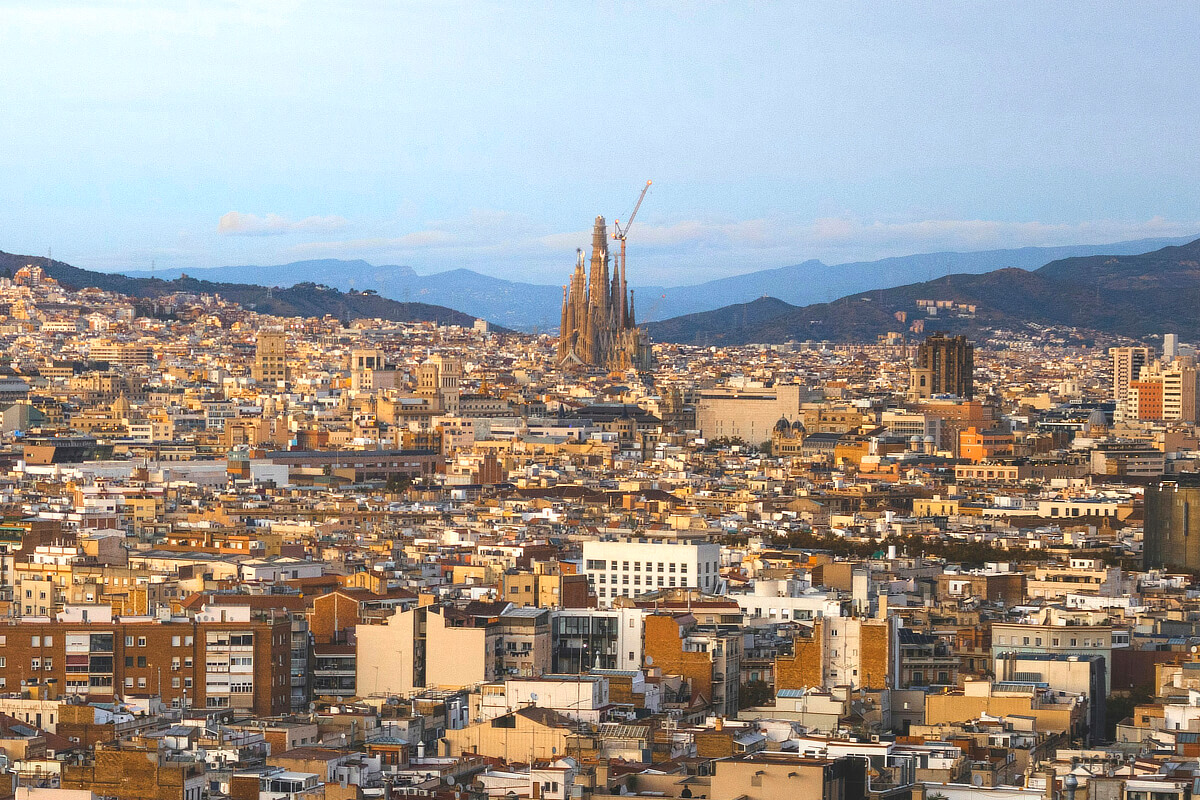
Sagrada Família shaping Barcelona’s cityscape, © Davit Margaryan/Unsplash
The Highly Anticipated Culmination of the Sagrada Familia
The article Antoni Gaudí and Contemporary Architecture already discussed the dilemmas involved in the construction of the Sagrada Familia with regard to its authorship. However, it is impossible to separate this building from Gaudí’s legacy, and in fact the inauguration of the Tower of Jesus Christ will be one of the most eagerly awaited events of the year. With this addition, the structure will reach a height of 172.5 meters, making it the tallest building in Barcelona and the tallest church in Europe.
Formally, the tower is clearly inspired by the Nativity Façade, whose design is unquestionably attributed to Gaudí. Its geometry is based on paraboloids and hyperboloids made with an innovative structure of prestressed stone panels, complemented by concrete ribs and some stone and ceramic cladding. This unique system reduces the total weight of the building while increasing its resistance to wind and earthquakes.
The perforations in the new tower do not follow the pattern of the original ones, but instead use a triangular tessellation found in other works by Gaudí, such as the Pavilions of the Güell Estate (1887) and the Music Room at Bellesguard.
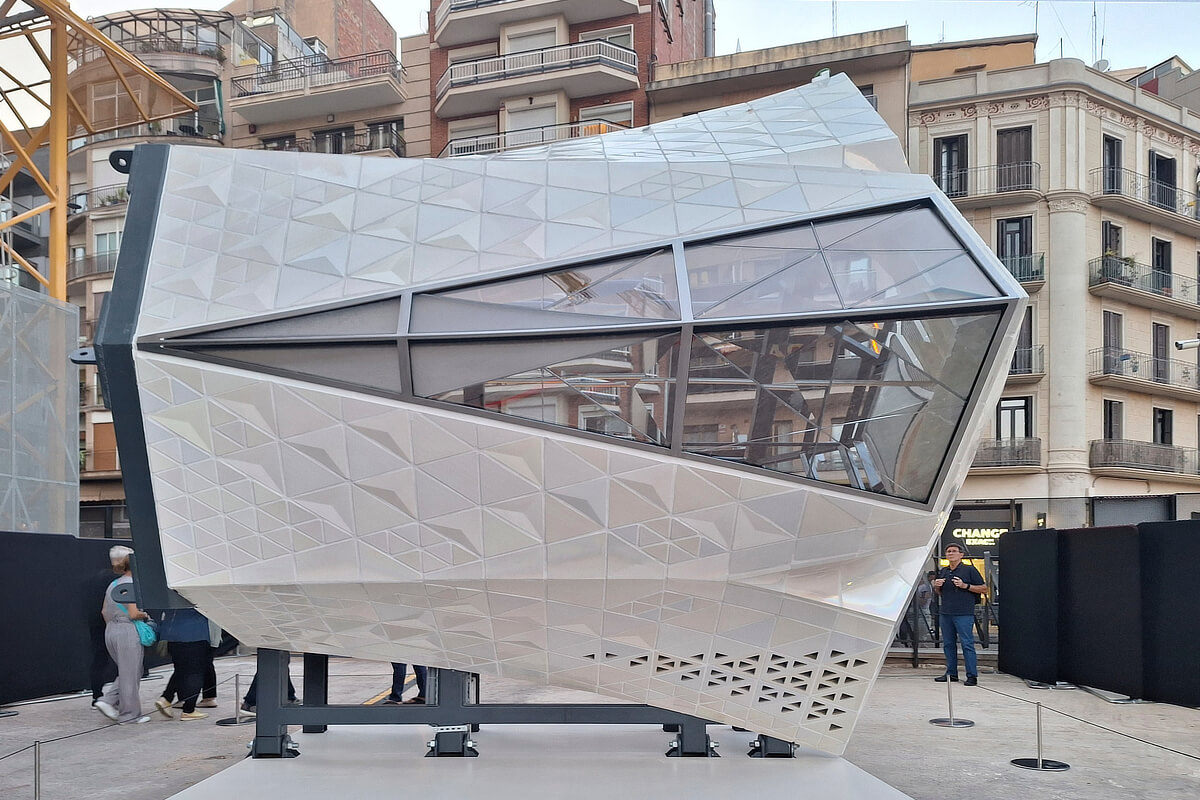
Prototype of one of the arms of the cross crowning the Sagrada Família, © Pere López Brosa, licensed under CC BY-SA 4.0, modified
The tower will be topped by a reinterpretation of the four-armed cross, created by Gaudí as a crowning element for civil buildings such as the Teresianas School (1894) and the Batlló House. As expected, the Sagrada Familia has also planned a program of educational, musical, and religious activities throughout 2026, including a mass scheduled for June 10th, the day of the centenary.
The International Congress on Gaudí at La Pedrera
According to the Barcelona City Council, one of the central events of the commemoration will be the 2026 Gaudí International Congress, which will take place during the month of June at Milà House, popularly known as La Pedrera.
The congress is being organized by the Department of Culture of the Generalitat with the participation of the Antoni Gaudí Council and the Gaudí Chair at the Polytechnic University of Catalonia. Although not all the details are known yet, this congress is shaping up to be one of the highlights of the year. Unlike other activities that are less focused on architecture, the conference has been designed with a highly scientific approach with the aim of presenting recent research, promoting interdisciplinary studies, and encouraging academic debate on Gaudí’s work.
Furthermore, the location could not be more ideal: both for its formal richness and its structural approach, the Milà House is considered by many architects and specialists to be the architect’s masterpiece.

Rooftop of Casa Milà, © Mauro Lima/Unsplash
A Magnificent Opportunity to Rediscover Antoni Gaudí
Overall, the Gaudí Year is presented as an ambitious, interdisciplinary celebration that goes beyond mere historical commemoration. Through exhibitions, academic meetings, projections, and concerts, Barcelona pays tribute to the iconic architect and offers resources for reinterpreting his work from contemporary and critical perspectives.
It is also an opportunity to book guided tours of Gaudí’s buildings offered by Guiding Architects Barcelona, which, as always, can be customized. The coincidence with Barcelona’s designation as World Capital of Architecture further reinforces this exceptional setting for delving into the cultural dimension of Antoni Gaudí’s legacy, which continues to inspire creators, researchers, and the general public a century after his death.
Text: Pedro Capriata
BIBLIOGRAPHY
Ajuntament de Barcelona (s.f.). Any Gaudí.
https://www.barcelona.cat/casalsdebarri/congresindians/es/agenda/any-gaudi
Bassegoda, J. (2002). Gaudí o Espacio, luz y equilibrio. Criterio Libros.
Capriata, P. (2024). Antoni Gaudí y la arquitectura contemporánea. Guiding Architects Barcelona.
https://www.gabarcelona.com/es/blog/antoni-gaudi-arquitectura-contemporanea/
Casa Batlló Contemporary (s.f.). Casa Batlló Exhibitions.
https://contemporary.casabatllo.es/en/exhibitions/
Centre Obert d’Arquitectura (s.f.). ArquitecturaCatalana.Cat.
https://www.arquitecturacatalana.cat/es
Consell Antoni Gaudí (s.f.). Programa Gaudí 2026.
https://consellantonigaudi.cat/programa-2026/
Gaudí, A. (1982). Manuscritos, artículos, conversaciones y dibujos. Colegio oficial de aparejadores y arquitectos técnicos de Madrid.
Generalitat de Catalunya (s.f.). Any Gaudí. Generalitat de Catalunya. Commemoracions.
https://web.gencat.cat/ca/generalitat/accio-govern/commemoracions/2026/any-gaudi
Giralt-Miracle, D. (2002). Gaudí: La recerca de la forma: Espai, geometria, forma i construcció. Ajuntament de Barcelona.
Herr, S. (2025). Barcelona, Capital Mundial de la Arquitectura 2026. Guiding Architects Barcelona.
https://www.gabarcelona.com/es/blog/barcelona-capital-mundial-arquitectura-2026/
Lahuerta, J. J. (1993). Antoni Gaudí 1852-1926: arquitectura, ideología y política. Electa.
Lahuerta, J. J. (2002). Casa Batlló. Gaudí. Barcelona. Triangle Postals.
Lahuerta, J. J. (2010). Humaredas. Arquitectura, ornamentación, medios impresos. Lampreave.
Lahuerta, J. J. (2016). Antoni Gaudí. Fuego y cenizas. Tenov.
Mesura (s.f.). Casa Batlló Contemporary.
https://www.mesura.eu/projects/casa-batllo-contemporary
Ramírez, J. A. (1992). Gaudí. Grupo Anaya.
Ramírez, J. A. (1998). La metáfora de la colmena: de Gaudí a Le Corbusier. Ediciones Siruela.
Solà-Morales, I. de (1983). Gaudí. Ediciones la Polígrafa.
Solà-Morales, I. de (1992). Arquitectura Fin de Siglo en Barcelona. Gustavo Gili.
Tarragó, S. (Ed.) (1991). Antoni Gaudí. Ediciones del Serbal.
Turismo de Catalunya (s.f.). 2026: arquitectura, genialidad y música en un destino cultural único. Generalitat de Catalunya.
https://www.catalunya.com/es/continguts/article/efemerides-culturales-catalunya-2026-1762268769121
Barcelona Celebrates the Gaudí Year 2026 With an Exciting Program of Activities
Exhibitions, Academic Events, Projections and Concerts Will Fill Barcelona to Commemorate the Centenary of Antoni Gaudí’s Death
Noble floor of Casa Batlló, courtesy of Casa Batlló
The Gaudí Year Takes Center Stage in Barcelona’s World Capital Role
In 2026, Barcelona will assume the status of World Capital of Architecture and will host numerous exhibitions, conferences, and events, including those planned to commemorate the Gaudí Year, marking the 100th anniversary of his death.
To celebrate the jubilee, a wide range of educational and academic activities, itineraries, and even concerts have been planned, dedicated to highlighting the legacy of Catalonia’s most international architect. Although the events mentioned will take place in various locations such as Mataró, Reus, Palma de Mallorca, and Comillas, Barcelona will clearly be the epicenter of the Gaudí Year, offering a unique opportunity to rediscover the work of this singular and visionary creator.
Antoni Gaudí’s architecture has fascinated generations of architects and enthusiasts due to its formal richness, symbolic complexity, and technical innovations. For those who are not very familiar with it, a brief introduction can be found in a previous Guiding Architects article: Antoni Gaudí and Contemporary Architecture. For a more detailed survey of the subject, some recommended reading is included at the end of this article.
Casa Vicens, © Pol Viladoms, licensed under CC BY-SA 4.0
Tradition and Restoration at the Vicens House
The Vicens House, Gaudí’s first major work, has only been open to the public for a few years compared to other buildings. However, it has established itself as an essential visit for fans of the architect and is joining in the commemoration with two main events.
The first has more to do with local tradition, but it can be an opportunity to see the building in a new light. It is the feast day of Saint Rita, patron saint of impossible causes, which has been celebrated at this location every May 22nd for more than 200 years.
The origin of this ritual is said to be linked to a fountain, now disappeared, whose waters were believed to have healing and even miraculous properties. In honor of Saint Rita, the gardens and terraces will be filled with roses that will then be blessed, following a custom that is particularly rooted in the Gracia neighborhood.
Smoking room at Casa Vicens, courtesy of Architekturzentrum Wien
From an architectural point of view, the restoration of the smoking room, scheduled for completion in November, will be even more interesting. This room is one of the most unique spaces in the house for many reasons, starting with its ornate Orientalist decoration and certain technical aspects.
Smoking rooms were popular in the last decades of the 19th century in various European countries. They can be found, for example, in Victor Horta’s projects in Brussels, such as the Tassel House (1894) and the Solvay House (1900). Tradition linked tobacco with the East, from where it was usually imported, so the choice of theme was not particularly surprising. What was surprising was the decision to use certain components, such as the muqarnas on the ceiling, inspired by the Alhambra in Granada, or the innovative papier-mâché tiles used to cover the walls.
Entrance of Palau Güell, © Thomas Ledl, licensed under CC BY-SA 4.0
The Universe of Gaudí in an Attractive Set of Exhibitions at Various Venues
Exhibitions on Gaudí and his work will be an important part of the program of activities. The Museu Nacional d’Art de Catalunya, for example, is presenting Gaudí and His Contemporaries, a series of themed virtual tours in the form of digital micro-stories. It will also incorporate previously unseen works by Gaudí and others into its permanent collection under the title More Gaudí, Reflections and Analogies.
Meanwhile, a temporary exhibition at the Museu d’Història de Catalunya offers an ambitious overview of Gaudí’s entire oeuvre, explaining both the architectural principles applied and their relationship to the historical, social, and technological context. The Palau Güell will also join the occurrence, hosting two other exhibitions with much more specific themes.
The first, entitled Gaudí, Windows to the Future, revolves around the openings in his work. Unique doors, windows, and stained glass are the material expression of new ways of understanding the use of light, the relationship between interior and exterior, and the connection between spaces. The second, Francesc Vidal i Jevellí at the Palau Güell, will focus on the furniture created specifically for this residence with the participation of cabinetmaker Vidal.
Sala de Maons at Torre Bellesguard, © Josep Bracons, licensed under CC BY-SA 2.0
Presentation of a Monograph and Concert at Torre Bellesguard
The activities of the Gaudí Year will also provide an opportunity to visit buildings not always accessible or lesser-known, such as the Figueras House, better known as Torre Bellesguard (1909), located in the upper part of Barcelona. The house takes its name from a castle that once stood on the site and is said to have belonged to King Martí the Humane.
The project is based on a square prism with added elements and, perhaps due to a desire to connect with history, seems particularly influenced by Gothic architecture. But as is usual in the architect’s work, to say that it is a neo-Gothic building would be an understatement. Both its structural brick arches and its decorative details unmistakably identify it as a Gaudí work.
This year, the building will host the presentation of the first monograph dedicated to it, written by Galdric Santana, current director of the Gaudí Chair. There will also be an opportunity to attend concerts by the renowned conductor and cellist Jordi Savall at Bellesguard, with a program dedicated to the architect.
New exhibition space at Casa Batlló by Mesura, © ethandeclerk
Newly Accessible Space in the Batlló House
The iconic Batlló House will also play a leading role in the celebrations. The inauguration of a new exhibition space located on the second floor, a level that until now could not be visited, stands out from an architectural perspective. The renovation, carried out by the Barcelona-based studio Mesura, carefully restores historical elements such as the woodwork, but also creates new ones such as the flooring and a distinctive false ceiling made of screen-printed metal pieces reminiscent of an inverted revoltó, a traditional local vaulting system.
Its organic shapes, materials, and engravings evoke aquatic effects, in harmony with the house’s courtyard, with the clear intention of establishing a dialogue between the Art Nouveau elements and the contemporary.
The new 230 m² art gallery will open with the exhibition Beyond the Façade by the United Visual Artists (UVA) collective, led by Matt Clark. Through works in various formats, such as audiovisual installations and kinetic sculptures, the show explores the duality of day/night and light/darkness, taking Gaudí’s work as its starting point.
The UVA team is also responsible for the mapping project entitled Hidden Order, which will initially only be on display on January 31st and February 1st. Created to complement the exhibition and celebrate the Gaudí Year, the projection explores the hidden geometries in nature that so fascinated the architect.
Sagrada Família shaping Barcelona’s cityscape, © Davit Margaryan/Unsplash
The Highly Anticipated Culmination of the Sagrada Familia
The article Antoni Gaudí and Contemporary Architecture already discussed the dilemmas involved in the construction of the Sagrada Familia with regard to its authorship. However, it is impossible to separate this building from Gaudí’s legacy, and in fact the inauguration of the Tower of Jesus Christ will be one of the most eagerly awaited events of the year. With this addition, the structure will reach a height of 172.5 meters, making it the tallest building in Barcelona and the tallest church in Europe.
Formally, the tower is clearly inspired by the Nativity Façade, whose design is unquestionably attributed to Gaudí. Its geometry is based on paraboloids and hyperboloids made with an innovative structure of prestressed stone panels, complemented by concrete ribs and some stone and ceramic cladding. This unique system reduces the total weight of the building while increasing its resistance to wind and earthquakes.
The perforations in the new tower do not follow the pattern of the original ones, but instead use a triangular tessellation found in other works by Gaudí, such as the Pavilions of the Güell Estate (1887) and the Music Room at Bellesguard.
Prototype of one of the arms of the cross crowning the Sagrada Família, © Pere López Brosa, licensed under CC BY-SA 4.0, modified
The tower will be topped by a reinterpretation of the four-armed cross, created by Gaudí as a crowning element for civil buildings such as the Teresianas School (1894) and the Batlló House. As expected, the Sagrada Familia has also planned a program of educational, musical, and religious activities throughout 2026, including a mass scheduled for June 10th, the day of the centenary.
The International Congress on Gaudí at La Pedrera
According to the Barcelona City Council, one of the central events of the commemoration will be the 2026 Gaudí International Congress, which will take place during the month of June at Milà House, popularly known as La Pedrera.
The congress is being organized by the Department of Culture of the Generalitat with the participation of the Antoni Gaudí Council and the Gaudí Chair at the Polytechnic University of Catalonia. Although not all the details are known yet, this congress is shaping up to be one of the highlights of the year. Unlike other activities that are less focused on architecture, the conference has been designed with a highly scientific approach with the aim of presenting recent research, promoting interdisciplinary studies, and encouraging academic debate on Gaudí’s work.
Furthermore, the location could not be more ideal: both for its formal richness and its structural approach, the Milà House is considered by many architects and specialists to be the architect’s masterpiece.
Rooftop of Casa Milà, © Mauro Lima/Unsplash
A Magnificent Opportunity to Rediscover Antoni Gaudí
Overall, the Gaudí Year is presented as an ambitious, interdisciplinary celebration that goes beyond mere historical commemoration. Through exhibitions, academic meetings, projections, and concerts, Barcelona pays tribute to the iconic architect and offers resources for reinterpreting his work from contemporary and critical perspectives.
It is also an opportunity to book guided tours of Gaudí’s buildings offered by Guiding Architects Barcelona, which, as always, can be customized. The coincidence with Barcelona’s designation as World Capital of Architecture further reinforces this exceptional setting for delving into the cultural dimension of Antoni Gaudí’s legacy, which continues to inspire creators, researchers, and the general public a century after his death.
Text: Pedro Capriata
BIBLIOGRAPHY
Ajuntament de Barcelona (s.f.). Any Gaudí.
https://www.barcelona.cat/casalsdebarri/congresindians/es/agenda/any-gaudi
Bassegoda, J. (2002). Gaudí o Espacio, luz y equilibrio. Criterio Libros.
Capriata, P. (2024). Antoni Gaudí y la arquitectura contemporánea. Guiding Architects Barcelona.
https://www.gabarcelona.com/es/blog/antoni-gaudi-arquitectura-contemporanea/
Casa Batlló Contemporary (s.f.). Casa Batlló Exhibitions.
https://contemporary.casabatllo.es/en/exhibitions/
Centre Obert d’Arquitectura (s.f.). ArquitecturaCatalana.Cat.
https://www.arquitecturacatalana.cat/es
Consell Antoni Gaudí (s.f.). Programa Gaudí 2026.
https://consellantonigaudi.cat/programa-2026/
Gaudí, A. (1982). Manuscritos, artículos, conversaciones y dibujos. Colegio oficial de aparejadores y arquitectos técnicos de Madrid.
Generalitat de Catalunya (s.f.). Any Gaudí. Generalitat de Catalunya. Commemoracions.
https://web.gencat.cat/ca/generalitat/accio-govern/commemoracions/2026/any-gaudi
Giralt-Miracle, D. (2002). Gaudí: La recerca de la forma: Espai, geometria, forma i construcció. Ajuntament de Barcelona.
Herr, S. (2025). Barcelona, Capital Mundial de la Arquitectura 2026. Guiding Architects Barcelona.
https://www.gabarcelona.com/es/blog/barcelona-capital-mundial-arquitectura-2026/
Lahuerta, J. J. (1993). Antoni Gaudí 1852-1926: arquitectura, ideología y política. Electa.
Lahuerta, J. J. (2002). Casa Batlló. Gaudí. Barcelona. Triangle Postals.
Lahuerta, J. J. (2010). Humaredas. Arquitectura, ornamentación, medios impresos. Lampreave.
Lahuerta, J. J. (2016). Antoni Gaudí. Fuego y cenizas. Tenov.
Mesura (s.f.). Casa Batlló Contemporary.
https://www.mesura.eu/projects/casa-batllo-contemporary
Ramírez, J. A. (1992). Gaudí. Grupo Anaya.
Ramírez, J. A. (1998). La metáfora de la colmena: de Gaudí a Le Corbusier. Ediciones Siruela.
Solà-Morales, I. de (1983). Gaudí. Ediciones la Polígrafa.
Solà-Morales, I. de (1992). Arquitectura Fin de Siglo en Barcelona. Gustavo Gili.
Tarragó, S. (Ed.) (1991). Antoni Gaudí. Ediciones del Serbal.
Turismo de Catalunya (s.f.). 2026: arquitectura, genialidad y música en un destino cultural único. Generalitat de Catalunya.
https://www.catalunya.com/es/continguts/article/efemerides-culturales-catalunya-2026-1762268769121
Related Posts
16.09.2026
The Urban Development Project That Defined Barcelona’s Identity.
30.06.2026
From a Landmark Public Library to Industrial Heritage Sites and FAD Award-Recognised Works.
16.06.2026
Several Projects Located in Barcelona Have Been Selected as Finalists for the FAD Architecture Awards.

11.05.2026
Barcelona Is Replacing Paved Areas Such as Intersections and Inner-Block Spaces With New Green Areas, Fostering Urban Ecological Regeneration.